Keeping a garden watered consistently is easier when a timer handles the schedule for you. Solar-powered irrigation timers can reduce battery changes while automating hoses, sprinklers, and soaker lines.
This roundup compares 10 options, from simple single-outlet controllers to Wi-Fi models and multi-zone systems, so you can match features and coverage to your garden.
Best 10 Solar Powered Irrigation Timers Picks for 2026
Best Solar-Powered Pick
RAINPOINT 21-Day Solar Sprinkler Timer

- Solar panel with up to 21 days of battery life under normal use
- Brass fittings and IP65 waterproof construction
- Flexible schedules, rain delay, and manual watering
Best For: Single-outlet garden watering with reduced battery maintenance
Best for Multiple Zones
Melnor AquaTimer 4-Zone Digital Timer

- Controls four zones independently
- Supports hourly-to-weekly scheduling
- Includes manual access and a 7-year limited warranty
Best For: Managing several watering areas from one faucet
Best Solar and Backup Charging
Type-C Rechargeable Sprinkler Timer
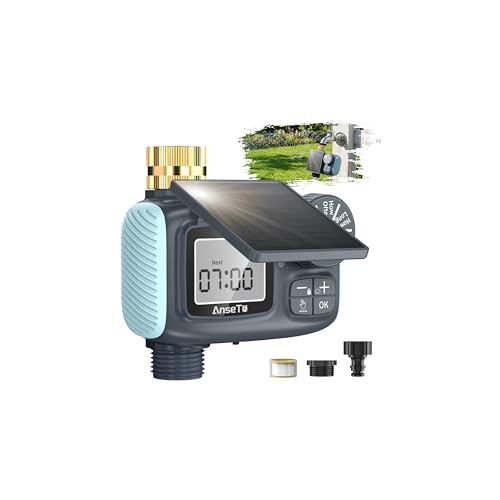
- Adjustable solar panel plus Type-C emergency charging
- Large LCD with schedule and power information
- Rain delay, manual mode, and flexible programming
Best For: Solar irrigation with a convenient backup charging method
Best Two-Pack Value
Orbit 1-Outlet Digital Hose Timer

- Includes two programmable hose timers
- LCD setup with start time, duration, and frequency
- Rain delay and program retention during battery changes
Best For: Equipping two separate faucets or watering points
Best Adjustable-Charging Pick
2-Zone Brass-Inlet Solar Timer

- Adjustable solar panel with rechargeable battery
- Brass inlet and IP55 waterproof construction
- Rain delay, child lock, and two-zone control
Best For: Gardeners wanting flexible solar charging and simple two-zone scheduling
Best Smart-App Option
Netro Wi-Fi Solar Sprinkler Timer

- Solar and Micro USB charging options
- Weather data and 60-day irrigation history
- Alexa, IFTTT, and plant-sensor compatibility
Best For: Connected gardens needing remote control and detailed watering records
Best Heavy-Duty Manual-Control Pick

- Brass inlet and outlet rated up to 116 psi
- Flexible schedules with rain-delay mode
- Readable LCD and independent manual watering
Best For: Gardeners prioritizing durable fittings and precise local controls
Smart Solar Pick
4-Zone WiFi Solar Timer 2-Pack

- App control for two independent watering zones
- Solar panel with backup battery
- Flow meter and automatic rain delay
Best For: Multi-zone lawn and garden watering
Programmable Value Pick

- Adjustable duration and watering frequency
- 24-, 48-, and 72-hour rain delay
- Large LCD with battery indicator
Best For: Simple single-zone hose watering
Leak-Resistant Basic Pick

- Large display with low-battery warning
- Built-in filter and weatherproof housing
- Rain delay plus manual watering mode
Best For: Basic outdoor watering with leak-conscious setup
Best Solar-Powered Pick – RAINPOINT 21-Day Solar Sprinkler Timer
For shoppers comparing solar powered irrigation timers, the RAINPOINT model stands out with a solar panel, low-power operation, and a claimed battery life of up to 21 days under normal watering frequency. Its flexible scheduling suits drip systems and sprinkler hoses.
Best For: Gardeners seeking a solar-powered, single-outlet timer for routine lawn, garden, greenhouse, or backyard watering.
Pros:
- Solar charging can reduce the need for frequent battery replacements.
- Schedules watering from every 1–12 hours or every 1–7 days, with durations up to 3 hours 59 minutes.
- Includes 24-, 48-, and 72-hour rain delay settings plus manual watering.
- Brass inlet and outlet fittings and an IP65 waterproof rating support outdoor use.
Cons:
- It is designed for one watering outlet.
- Solar performance depends on available sunlight.
This is a practical choice if minimizing battery maintenance is a priority. The brass connections and broad schedule range add useful durability and flexibility for everyday irrigation.
Best for Multiple Zones – Melnor AquaTimer 4-Zone Digital Timer
Although it is battery powered rather than solar powered, the Melnor AquaTimer is worth considering alongside solar powered irrigation timers when one faucet needs to manage several watering areas. It independently controls four zones and supports schedules from hourly to weekly.
Best For: Homeowners who need separate schedules for up to four watering zones from one faucet.
Pros:
- Four independent zones allow different watering schedules for separate areas.
- Programs watering as often as hourly or as little as once per week.
- Watering durations range from 1 minute to 6 hours.
- Offers manual faucet access and a 7-year limited warranty.
Cons:
- Requires two AA batteries, which are not included.
- It does not use solar charging.
The Melnor is the strongest option here for multi-zone control, but buyers specifically seeking solar operation will need to look elsewhere. Its long warranty and independent programming make it a capable conventional alternative.
Best Solar and Backup Charging – Type-C Rechargeable Sprinkler Timer
This solar powered irrigation timer combines an adjustable solar panel with a 1000mAh rechargeable battery and Type-C emergency charging. It also provides a large LCD display, broad schedule settings, and rain delay controls for flexible garden watering.
Best For: Users who want solar charging with a Type-C backup option and an easy-to-read programming display.
Pros:
- Uses an adjustable 0–120° solar panel with Type-C backup charging.
- Schedules watering from every 1–12 hours or every 1–7 days, for durations up to 3 hours 59 minutes.
- Large 40-by-30-millimeter LCD shows settings, power, and the next watering time.
- Includes 24-, 48-, and 72-hour rain delay and manual watering modes.
Cons:
- Solar charging still depends on sufficient sunlight for routine operation.
- Its IPX5 rating and plastic construction differ from the RAINPOINT model’s IP65 and brass fittings.
The combination of adjustable solar charging and Type-C backup makes this a versatile pick for variable weather. Its display is especially useful for checking schedules and remaining power at a glance.
Best Two-Pack Value – Orbit 1-Outlet Digital Hose Timer
The Orbit 62067 is another battery-powered alternative for shoppers comparing solar powered irrigation timers. This two-pack provides a programmable timer for each of two faucets or watering points, with an LCD screen, rain delay, and schedules based on start time, duration, and frequency.
Best For: Homeowners who need two separate single-outlet timers for straightforward automatic watering.
Pros:
- Two timers are included in the package.
- LCD programming lets users set start time, duration, and frequency.
- Rain delay can pause watering for 24, 48, or 72 hours.
- The program is retained when batteries are changed.
Cons:
- It is battery powered rather than solar powered.
- Each unit controls only one outlet.
This pack makes sense when two independent watering points matter more than solar charging. It offers basic scheduling and rain-delay functionality in a convenient two-unit package.
Best Adjustable-Charging Pick – 2-Zone Brass-Inlet Solar Timer
For shoppers comparing solar powered irrigation timers, this model stands out for its adjustable solar panel, rechargeable battery, and two-zone design. Its large display and straightforward dial-and-button controls make it practical for customizing watering schedules.
Best For: Gardeners who want flexible solar charging, two-zone watering, and simple on-device programming.
Pros:
- Adjustable panel angles help optimize sunlight exposure.
- Brass inlet, metal threads, and IP55 waterproofing support outdoor use.
- Rain delay offers 24-, 48-, or 72-hour pauses, while child lock helps prevent accidental changes.
- Rechargeable battery supports continuous use without frequent battery replacement.
Cons:
- Charging flexibility still depends on receiving sufficient sunlight or using USB-C charging.
- The casing is plastic, despite the brass inlet and metal threads.
This is a well-rounded choice when durable connections and adaptable solar positioning matter. It is especially useful for gardens with changing sun angles or separate watering zones.
Best Smart-App Option – Netro Wi-Fi Solar Sprinkler Timer
Among solar powered irrigation timers, the Netro is the choice for gardeners who prefer app-based control and detailed watering data. It combines solar and Micro USB charging with weather information, recurring schedules, and optional plant-sensor integration.
Best For: Connected gardens where remote scheduling, weather-aware planning, and irrigation history are priorities.
Pros:
- Supports both solar charging and Micro USB charging.
- The app provides location-based weather data and stores up to 60 days of irrigation history.
- Flexible scheduling includes daily intervals, weekly plans, and odd/even days.
- Compatible with Alexa and IFTTT, with support for pairing to a Netro plant sensor.
Cons:
- App control requires a 2.4G Wi-Fi connection for pairing.
- More setup and connectivity are involved than with a basic dial-controlled timer.
- The device should be kept dry while charging the battery.
This model is best suited to users comfortable managing irrigation through an app. Its plant library, weather data, and historical logs offer more oversight than a conventional hose timer.
Best Heavy-Duty Manual-Control Pick – Brass Rainpoint Hose Timer
Although it is not solar powered, this RAINPOINT timer is a useful comparison for shoppers evaluating solar powered irrigation timers who also value rugged hose connections and dependable local controls. It offers brass inlet and outlet fittings, broad schedule ranges, and a readable LCD screen.
Best For: Gardeners who prioritize durable fittings and precise on-device scheduling over solar operation.
Pros:
- Pure brass inlet and outlet fittings are rated to withstand up to 116 psi.
- Programming supports durations from 1 minute to 3 hours 59 minutes and frequencies from hourly to weekly.
- Rain delay pauses schedules for 24, 48, or 72 hours and resumes automatically.
- Manual watering can run from 1 minute to 8 hours without interrupting the programmed schedule.
Cons:
- It is not solar powered and therefore does not match the keyword category directly.
- The supplied details list one setting, so it is not presented as a multi-zone timer.
This is a sensible alternative when robust brass connections and highly adjustable manual programming matter more than renewable charging. Consider it alongside solar models if outdoor durability is your primary concern.
Smart Solar Pick – 4-Zone WiFi Solar Timer 2-Pack
For shoppers seeking solar powered irrigation timers with app control, the EZAIoT 2-pack combines remote scheduling, two independent watering zones, and solar charging. Its flow meter and rain-delay feature add useful oversight for lawns, gardens, and drip systems.
Best For: Homeowners managing separate lawn and garden zones who want smart, hub-free control.
Pros:
- Controls two independent zones remotely through a free iOS/Android app, with no hub or subscription.
- Solar panel and backup battery eliminate routine battery replacement or manual charging.
- Flow monitoring and weather-based rain delay can help reduce unnecessary watering.
- Includes brass inlets, a hose splitter, and compatibility with standard hoses, sprinklers, and drip systems.
Cons:
- Requires a 2.4GHz WiFi connection and app setup.
- Low-flow systems may require using the more precise Time Mode rather than Volume Mode.
- The two-timer setup may be more capability than needed for a single watering zone.
This is the most feature-rich option in the group, particularly for multi-zone watering and consumption tracking. Choose it if smart controls and solar operation matter more than keeping the setup basic.
Programmable Value Pick – RAINPOINT 1-Outlet Hose Timer
This RAINPOINT timer is a straightforward choice for programmed hose watering, with adjustable start times, durations, and watering intervals. It is not solar powered, using two AA alkaline batteries, but its large LCD and flexible rain-delay settings make routine irrigation easy to manage.
Best For: Gardeners who want simple, customizable scheduling for one hose outlet.
Pros:
- Sets watering duration from 1 minute to 3 hours 59 minutes.
- Supports frequencies from every hour to every 12 hours or every 1 to 7 days.
- Includes 24-, 48-, and 72-hour rain-delay options that resume the schedule automatically.
- Large LCD displays watering information, frequency, and battery status.
Cons:
- Requires two AA alkaline batteries, which are not included.
- Single-outlet design cannot independently control multiple watering zones.
- It does not provide solar charging or smart app control.
For buyers who value clear programming over connected features, this is a practical one-outlet timer. Its broad scheduling range and manual mode suit everyday lawn, yard, and garden watering.
Leak-Resistant Basic Pick – RAINPOINT Outdoor Hose Timer
For a basic alternative to solar powered irrigation timers, this RAINPOINT outdoor model focuses on readable controls, weather-resistant construction, and leak-conscious installation. It uses battery power and adds manual watering, rain delay, and a low-battery shutoff reminder.
Best For: Users who want a simple outdoor hose timer with weather protection and leak-focused features.
Pros:
- Large display shows watering time, frequency, and battery status.
- Built-in inlet filter and weatherproof housing are designed for outdoor use.
- Rain delay pauses watering for 24, 48, or 72 hours.
- Manual watering can be set from 1 minute to 8 hours without interrupting the schedule.
Cons:
- Uses batteries rather than solar power.
- Plastic construction may be less substantial than a brass-inlet timer.
- Users may need faucet thread tape to help secure a leak-resistant connection.
This model is a sensible fit when straightforward outdoor operation is the priority. Its low-battery warning and automatic valve closure provide useful safeguards for unattended watering, while the rain-delay and manual modes cover common garden needs.
How We Picked the Best Solar Powered Irrigation Timers
We focused on the features that affect everyday watering: power method, scheduling flexibility, outlet or zone count, weather resistance, connection type, installation requirements, and manual-control options. We also considered whether a timer is better suited to a small container garden, a lawn, raised beds, or a larger irrigation layout.
Because “solar-powered” products vary, check whether the panel is integrated, whether the unit includes a rechargeable battery, and whether USB or Type-C charging is available as a backup. Solar exposure can affect reliability, particularly when the timer is mounted under foliage or beside a shaded wall.
Quick Comparison
| Best For | Look For | Typical Choice |
|---|---|---|
| Small gardens | One outlet and simple schedules | Basic programmable hose timer |
| Multiple watering areas | Two or more independent zones | Multi-zone controller |
| Remote management | Wi-Fi app support and stable 2.4GHz connectivity | Smart solar timer |
| Water-conscious watering | Rain delay, flow monitoring, and manual override | Advanced smart model |
Key Buying Factors for Solar-Powered Irrigation Timers
Power and Solar Placement
Choose a panel location with several hours of direct sunlight. A rechargeable battery helps maintain schedules overnight and during cloudy periods. If the timer will sit in shade, prioritize models with Type-C or USB backup charging.
Zones, Outlets, and Water Pressure
A single outlet is usually enough for one hose line. Select a two-zone or four-zone model when beds, containers, lawn areas, or drip systems need different schedules. Confirm that your faucet, hose, splitter, and irrigation fittings use compatible connections and can provide adequate pressure.
Scheduling and Weather Controls
Useful scheduling features include multiple start times, adjustable run duration, specific watering days, rain delay, and manual watering. Rain delay is especially valuable when a timer has no access to local weather data.
Smart Features and Durability
Wi-Fi control can make schedule changes convenient, but it adds setup and connectivity requirements. Look for 2.4GHz compatibility, a clear app, and dependable local controls. Brass inlets and outlets may offer better resistance to wear than basic plastic fittings, while every outdoor timer should be protected from prolonged submersion.
Who Should Buy Which Solar Powered Irrigation Timers?
Choose a basic single-outlet timer if you want dependable automatic watering for one hose with minimal setup. Pick a two-zone model when separate areas need different run times. A four-zone controller is better for larger gardens or several watering circuits, provided your water supply can support them.
Choose a Wi-Fi solar timer if you value app-based adjustments, flow information, or remote monitoring. For budget-conscious buyers, a non-smart programmable model with rain delay and manual override can deliver the essential benefits without relying on an app. Before buying, measure the faucet area, identify the number of irrigation lines, and verify direct-sun exposure for the solar panel.