Managing several garden beds, lawn sections, or drip lines is easier with a timer that can control each watering zone independently. The best multi-zone models let you customize schedules, pause watering after rain, and reduce the daily work of moving hoses or adjusting valves.
This roundup compares 10 irrigation timers for multiple zones, including indoor/outdoor sprinkler controllers, hose timers, and smart-enabled options. Use the buying guide below to match zone capacity, controls, durability, and installation style to your yard.
Best 10 Irrigation Timers for Multiple Zones Picks for 2026
Best Overall
Orbit 4-Station Swing Panel Timer

- Four-zone residential control
- Indoor/outdoor locking cabinet
- Cycle-and-soak and rain-skip features
Best For: Homeowners wanting detailed four-zone scheduling
Best Scheduling Flexibility

- Independent four-zone schedules
- Hourly-to-weekly frequency options
- Manual mode and seven-day rain delay
Best For: Gardens with varied watering routines
Best Smart Control
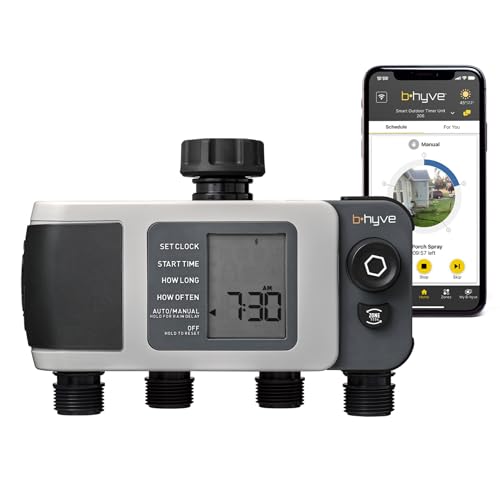
- Four-port multi-zone watering
- Bluetooth phone programming
- Smart WeatherSense adjustments
Best For: Users wanting app-controlled hose watering
Best for Gardeners
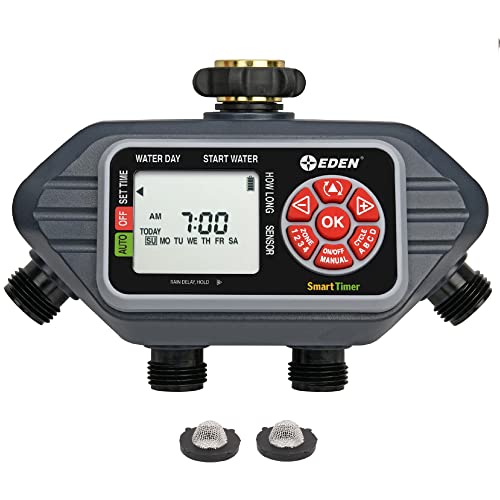
- Four independent watering zones
- Large display and raised buttons
- Optional soil-moisture sensor support
Best For: Gardeners wanting simple, flexible zone control
Flexible Four-Zone Control

- Four independently programmable outlets
- 1–360-minute watering duration
- Rain delay and child lock included
Best For: Mixed gardens needing four sequential schedules
Simple Programmable Choice

- Three-outlet battery-powered design
- Clear LCD programming screen
- Built-in rain delay and six-year warranty
Best For: Basic automated lawn and garden watering
Durable Independent Scheduling

- Three independent zones can run simultaneously
- 1-minute to 8-hour duration range
- Brass fittings and IP65 weather resistance
Best For: Mixed outdoor areas needing separate concurrent schedules
Best 4-Zone Flexibility
RAINPOINT 4-Outlet Sprinkler Timer

- Four independent programmable zones
- Rain delay for 24, 48, or 72 hours
- Large LCD and beginner-friendly controls
Best For: Managing different watering schedules across four outdoor areas
Best 2-Zone Value

- Separate schedules for two zones
- IP65 waterproof design
- Low-battery warning and automatic valve closure
Best For: Two-area watering setups that prioritize simple operation
Best Simple 4-Zone Setup
RAINPOINT Programmable Sprinkler Timer

- Four individually programmable zones
- Large 3.4-inch LCD and control dial
- Manual watering without changing schedules
Best For: First-time users managing four standard hose-connected zones
Best Overall – Orbit 4-Station Swing Panel Timer
For homeowners comparing irrigation timers for multiple zones, the Orbit 57894 offers four-station control with flexible indoor or outdoor installation. Its custom intervals, cycle-and-soak programming, overlapping runtime stacking, and rain-skip delay provide useful scheduling control for residential lawns.
Best For: Homeowners who want a durable four-zone controller with detailed scheduling options.
Pros:
- Controls four watering zones independently.
- Supports indoor or outdoor mounting in a locking cabinet.
- Offers cycle-and-soak, runtime stacking, and rain-skip features.
- Includes a six-year parts warranty.
Cons:
- Uses a physical interface rather than app-based control.
- Requires a 24-volt irrigation setup.
This is a strong conventional controller for installations where zone-by-zone scheduling and weather-resistant placement matter more than smartphone access.
Best Scheduling Flexibility – Melnor AquaTimer 4-Zone
The Melnor AquaTimer is a practical choice among irrigation timers for multiple zones when you need independent schedules from one faucet. Each of its four valves can run from one minute to six hours, with frequencies ranging from hourly to weekly.
Best For: Gardeners who want highly flexible watering frequency and straightforward digital controls.
Pros:
- Provides independent scheduling for four zones.
- Allows hourly-to-weekly watering schedules.
- Supports runtimes from one minute to six hours.
- Includes manual watering and a seven-day rain delay.
Cons:
- Requires two AA batteries, which are not included.
- Made primarily from plastic.
Its broad scheduling range makes it especially useful for gardens with different watering needs, while the manual option keeps faucet access convenient for occasional tasks.
Best Smart Control – Orbit B-hyve XD 4-Port Timer
For shoppers seeking irrigation timers for multiple zones with connected control, the Orbit B-hyve XD manages four outlets and can be programmed from a phone over Bluetooth. Its Smart WeatherSense feature is designed to adjust watering for weather and drought conditions.
Best For: Users who prefer app-based scheduling and weather-responsive watering for hose-connected zones.
Pros:
- Controls four watering outlets for multiple areas.
- Offers wireless phone programming through Bluetooth.
- Includes Smart WeatherSense weather and drought monitoring.
- Provides automated scheduling for gardens, lawns, and flower beds.
Cons:
- Bluetooth control may be less suitable for users wanting a traditional controller.
- Its smart features depend on using the compatible app and wireless connection.
This model stands out when remote scheduling and weather-aware automation are priorities, particularly for hose-based watering across separate garden areas.
Best for Gardeners – Eden 93413 4-Zone Timer
Eden 93413 Programmable Digital Water Timer 4-Zone, Compatible with Wireless Soil Moisture Sensor
Check Price On AmazonThe Eden 93413 is a useful option among irrigation timers for multiple zones, with four independent valves, a large display, and raised buttons for setup. It also supports multiple start times, manual watering, rain delay, and optional wireless soil-moisture sensor compatibility.
Best For: Gardeners who want independent schedules, accessible controls, and added moisture-sensor compatibility.
Pros:
- Operates four areas with fully independent schedules.
- Supports multiple start times and one-minute-to-six-hour runtimes.
- Includes manual watering and rain-delay functions.
- Features a metal inlet, leak-resistant connector, and built-in filter.
Cons:
- The wireless soil-moisture sensor is sold separately.
- Its display is smaller than some larger controller panels.
The Eden combines approachable programming with useful hardware protection, making it a good fit for gardeners who want flexibility without app-based controls.
Flexible Four-Zone Control – Insoma 4-Zone Hose Timer
For shoppers comparing irrigation timers for multiple zones, the Insoma offers four independently programmable outlets for separating watering plans across gardens, lawns, greenhouses, or other outdoor areas. Its zones run one by one according to their start times rather than simultaneously.
Best For: Gardeners who need four customizable watering schedules from one faucet connection.
Pros:
- Four independent outlets support different watering plans.
- Adjustable start time, frequency, and duration from 1 to 360 minutes.
- Includes manual watering, 1-to-15-day rain delay, and child-lock modes.
- IPX5 waterproof construction with an anti-UV, anti-rust design.
Cons:
- The four outlets cannot operate at the same time.
- Requires four AA alkaline batteries, which are not included.
The Insoma is a versatile choice when scheduling flexibility matters more than simultaneous watering. Its detailed display and broad duration range make it practical for mixed planting areas, though sequential zone operation may limit higher-demand irrigation setups.
Simple Programmable Choice – Orbit 3-Outlet Digital Timer
The Orbit 56082 is a straightforward option for irrigation timers for multiple zones, with a three-outlet design, digital scheduling, and a clear LCD screen. Its battery-powered format is suited to homeowners who want automatic watering without a more complex controller.
Best For: Homeowners seeking an easy-to-program digital timer for routine lawn and garden watering.
Pros:
- Three-outlet design supports multi-area watering from one faucet.
- LCD screen simplifies schedule programming.
- Built-in rain delay helps pause watering during wet weather.
- Includes a six-year limited warranty for private use.
Cons:
- The supplied notes describe fewer scheduling details than the other multi-zone models.
- Uses plastic construction rather than brass fittings.
Orbit focuses on uncomplicated controls and dependable everyday operation. It is a sensible pick for basic automated watering, while shoppers needing highly detailed, independently customized zone schedules may prefer a model with more explicitly stated programming ranges.
Durable Independent Scheduling – RAINPOINT 3-Zone Timer
For irrigation timers for multiple zones that emphasize separate schedules and outdoor durability, the RAINPOINT 2027 V2 provides three independent zones with adjustable frequency and duration. Solid brass fittings, an IP65 rating, and a sunlight-readable display support regular outdoor use.
Best For: Garden, lawn, yard, and greenhouse watering that requires distinct schedules for each zone.
Pros:
- Three zones support independent schedules and can irrigate simultaneously.
- Duration adjusts from 1 minute to 8 hours, with 1-hour to 7-day frequency settings.
- Solid brass inlet and outlet are designed to reduce leakage.
- IP65 waterproofing, UV-resistant housing, and 24/48/72-hour rain delay add outdoor practicality.
Cons:
- The supplied notes do not specify battery type or expected battery life.
- Three zones provide less expansion than four-zone alternatives.
The RAINPOINT is the strongest fit here for users who want independently scheduled zones with simultaneous operation and robust fittings. Its broad duration range is useful for varied planting areas, while the weather-resistant housing supports year-round outdoor installation.
Best 4-Zone Flexibility – RAINPOINT 4-Outlet Sprinkler Timer
For shoppers comparing irrigation timers for multiple zones, this RAINPOINT model stands out with four independently programmable outlets. Each zone can have its own start time, duration, and watering frequency, making it practical for gardens, lawns, and other areas with different watering needs.
Best For: Homeowners who need four separate watering schedules from one hose timer.
Pros:
- Four independently customizable zones
- Run times range from 1 minute to 3 hours 59 minutes
- 24-, 48-, and 72-hour rain-delay options
- Large 3.4-inch LCD, rotating dial, and clear buttons
Cons:
- Uses a 3/4-inch faucet and hose connection
- Its broad feature set may be more than needed for a single-zone setup
This is a strong choice when flexibility matters most. The separate zone programming and extended manual-watering range make it useful for varied outdoor watering tasks, while the display and controls aim to keep setup approachable.
Best 2-Zone Value – RAINPOINT 2-Zone Hose Timer
This two-zone RAINPOINT timer is a practical pick among irrigation timers for multiple zones when you only need to control two areas. It supports separate schedules, automatic, manual, and rain-delay modes, plus a low-battery warning that closes the valve when battery power is low.
Best For: Users watering two zones who want simple controls and durability-focused features.
Pros:
- Two separately programmable zones
- Upgraded valves reduce flow resistance by 40%
- IP65 waterproof rating and tested for 20,000 cycles
- Clear display with low-battery warning
Cons:
- Limited to two zones
- Requires compatible 3/4-inch faucet and pipe connections
- The supplied specifications list slightly different display sizes
With its two-zone layout, straightforward interface, and automatic valve closure on low battery, this model emphasizes convenient everyday operation. Verify the faucet condition and 3/4-inch compatibility before purchasing.
Best Simple 4-Zone Setup – RAINPOINT Programmable Sprinkler Timer
If you need irrigation timers for multiple zones but prefer a straightforward interface, this RAINPOINT four-zone timer offers independent scheduling for each area. Its large display and dial help simplify programming, while rain delay and manual watering cover common changes to an automatic routine.
Best For: First-time users who need four-zone scheduling for a standard garden hose setup.
Pros:
- Four individually programmable zones
- Flexible cycles from every 8 or 12 hours to every 1–7 days
- Manual watering can run from 1 minute to 8 hours
- Fits 3/4-inch faucets and standard garden hoses
Cons:
- It is designed for 3/4-inch connections
- The scheduling options may be more extensive than necessary for basic watering needs
This model balances multi-zone control with a beginner-friendly layout. It is particularly useful for gardeners who want distinct schedules for several areas without changing their automatic programs when occasional manual watering is needed.
How We Picked the Best Irrigation Timers for Multiple Zones
We focused on timers with two or more independently controllable outlets or stations, because separate schedules are the main advantage of a multi-zone system. We also considered programming flexibility, manual watering, rain-delay functions, power requirements, weather resistance, connection design, and compatibility with common hoses, sprinklers, drip systems, and soaker hoses.
The selection includes both faucet-mounted hose timers and traditional sprinkler controllers. That range matters: a hose timer is usually simpler for patio gardens and container plants, while a station-based controller is often better for wired irrigation valves and permanent lawn systems.
Quick Comparison
| Best For | Recommended Type | What to Prioritize |
|---|---|---|
| Small gardens and containers | 2-zone hose timer | Simple scheduling and compact installation |
| Multiple beds or hose lines | 3- or 4-zone hose timer | Independent programs and strong fittings |
| Permanent sprinkler systems | 4-station controller | Valve compatibility and indoor/outdoor mounting |
| Remote monitoring | Smart watering timer | App control, connectivity, and alerts |
Key Buying Factors for Multi-Zone Irrigation Timers
Zone Capacity and Scheduling
Choose a timer with enough zones for your current layout, then consider future expansion. Independent schedules are especially useful when plants have different water needs or when low-pressure lines should not run at the same time. Check whether each zone supports its own start time, duration, and watering days.
Installation and Compatibility
Faucet-mounted units connect directly to an outdoor tap and typically use hose-thread fittings. Station controllers usually connect to low-voltage sprinkler valves and may require wiring, a power adapter, or indoor mounting. Confirm the timer’s connection type before buying, and verify that your water pressure and flow can support multiple outlets.
Weather Resistance and Construction
Outdoor timers should have a sealed housing and clearly stated water resistance. Brass inlets and outlets can provide a sturdier connection than lightweight plastic, but they do not replace proper washers and careful installation. Use a filter or pressure regulator when your drip system requires one.
Controls, Power, and Rain Management
LCD controls are convenient when you want to program the unit at the faucet. Smart models can add remote adjustments and notifications, but they depend on compatible wireless connectivity. Battery life is another practical consideration. A rain-delay feature lets you pause watering without deleting schedules, which helps conserve water during changing weather.
Who Should Buy Which Irrigation Timers for Multiple Zones?
Choose a two-zone model for a compact yard, raised beds, or a few container groups. A three-zone timer suits homes with separate lawn, garden, and drip areas. Four-zone hose timers are better for larger gardens or several watering lines, while a four-station controller is the stronger choice for a built-in sprinkler system. If convenience and remote access matter most, select a smart-compatible model; if reliability and simplicity are priorities, a programmable digital timer with manual and rain-delay controls is usually the better value.