Sharing a bedroom does not have to mean sacrificing floor space, storage, or personal comfort. The right bunk bed gives siblings a practical sleep arrangement while opening room for play, homework, and belongings.
This roundup compares 10 bunk beds for shared bedrooms, including twin-over-twin, twin-over-full, full-over-full, trundle, L-shaped, wood, and metal designs. Use the guide below to match your room dimensions, sleepers, and storage needs to the best style.
Best 10 Bunk Beds for Shared Bedrooms Picks for 2026
Heavy-Duty Pick

- 400-pound capacity with a square-tube frame
- Reversible ladder and under-bed storage
- Quiet metal-slatted design needs no box spring
Best For: Shared rooms needing a sturdy twin-over-full configuration
Most Flexible Layout
Convertible Twin Metal Bunk Bed

- Separates into two twin beds
- 16.5-inch upper guardrails
- Reversible ladder plus storage accessories
Best For: Shared rooms that may later need separate beds
Storage-Focused Choice
Classic Twin Over Full Wood Bunk Bed

- Solid New Zealand pine construction
- Two under-bed storage drawers
- 400-pound capacity per bed
Best For: Kids’ rooms needing wood style and built-in storage
Compact Twin Option
Enclosed-Guardrail Metal Bunk Bed

- Twin-over-twin space-saving design
- Fully enclosed upper guardrails
- 400-pound capacity for each layer
Best For: Children sharing a smaller bedroom
Best for Sleepovers
L-Shaped Twin Bunk Bed for Four
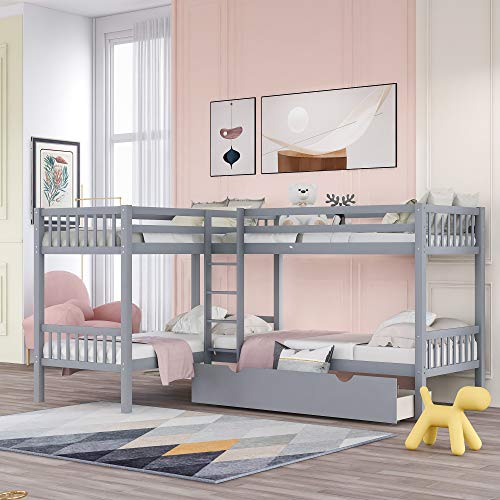
- Sleeps four with four twin-size bed spaces
- Storage drawers and solid pine construction
- Full-length guardrails and lower headboard and footboard
Best For: Shared rooms, sleepovers, and guest spaces needing four beds
Best Convertible Option
Full-Over-Full Bunk Bed with Trundle

- Full-over-full layout offers roomy sleeping surfaces
- Pullout twin trundle adds guest capacity
- Converts into two separate full platform beds
Best For: Kids' or teens' shared rooms with flexible guest sleeping needs
Best for Built-In Storage
Twin-Over-Twin Bunk Bed with Stairs

- Eight drawers are built into the stairs and bed
- Wide stairs provide an alternative to a ladder
- Includes guardrails, anti-tip kit, and LED lighting
Best For: Shared rooms needing accessible storage and space-saving organization
Space-Saving Wood Pick
Giantex Twin-Over-Twin Bunk Bed

- Pine wood frame with sturdy slats
- 12-inch guard rails and anti-tip support
- 12.5 inches of under-bed storage clearance
Best For: Shared bedrooms and compact rooms needing simple wood bunk beds
Flexible Metal Choice
Jocoevol Convertible Twin Bunk Bed

- Converts into two individual twin beds
- 16.5-inch full-length guardrails
- Reversible ladder and open under-bed storage
Best For: Shared bedrooms needing long-term sleeping flexibility
Feature-Packed Storage Pick
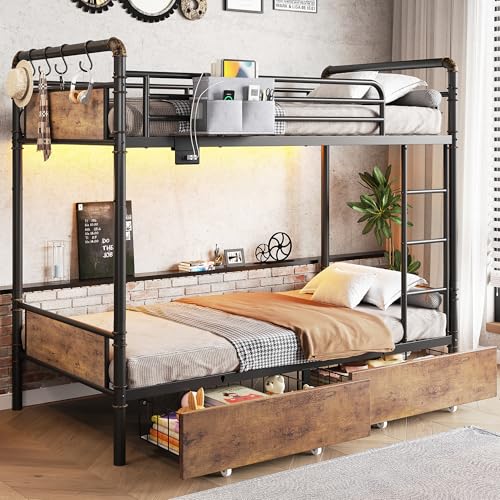
- Two drawers plus bedside storage accessories
- RGB lighting with app or remote control
- Movable USB and Type-C charging station
Best For: Tech-friendly shared bedrooms needing extra organization
Heavy-Duty Pick – Twin Over Full Metal Bunk Bed
For families seeking bunk beds for shared bedrooms, this twin-over-full metal model combines a compact footprint with a larger lower sleeping surface. Its square-tube frame, metal slats, and under-bed clearance make it a practical choice for teens, adults, or mixed-age rooms.
Best For: Shared bedrooms needing a sturdy twin-over-full layout and flexible ladder placement.
Pros:
- Supports up to 400 pounds with a heavy-duty square-tube frame.
- Reversible ladder can be installed on either side.
- Metal slats eliminate the need for a box spring.
- Mute buckle design helps reduce slat movement and noise.
Cons:
- Assembly is recommended for two people.
- The upper mattress must sit at least 5 inches below the guardrail.
- Wall-securement hardware may be needed for added stability.
This is a strong space-saving option when siblings or roommates need different bed sizes. The twin-over-full configuration offers extra room below, while the reversible ladder helps accommodate varied room layouts.
Most Flexible Layout – Convertible Twin Metal Bunk Bed
These bunk beds for shared bedrooms are designed to adapt as room arrangements change. The twin-over-twin metal frame converts into two separate beds, while tall guardrails, under-bed storage, and a reversible ladder add everyday practicality.
Best For: Children, teenagers, or adults who may eventually need two independent twin beds.
Pros:
- Converts from a bunk bed into two separate single beds.
- 16.5-inch guardrails provide substantial upper-bed protection.
- Reversible ladder suits different room layouts.
- Includes a bedside storage bag, four hooks, and 11.2 inches of under-bed clearance.
Cons:
- Assembly requires careful installation before fully tightening screws.
- The industrial metal design may not suit every bedroom style.
- Weight limits differ between the lower and upper beds.
Its convertible design gives this model longer-term usefulness than a fixed bunk configuration. It is especially practical for shared rooms that may later become separate bedrooms or dorm-style spaces.
Storage-Focused Choice – Classic Twin Over Full Wood Bunk Bed
For shared bedrooms that need a warmer, furniture-style look, this pine twin-over-full bunk bed pairs solid wood construction with built-in under-bed drawers. The lower full-size bed gives one sleeper extra room, while metal reinforcement supports everyday use.
Best For: Kids’ shared bedrooms where wood styling and under-bed drawer storage are priorities.
Pros:
- Made from solid New Zealand pine with a low-VOC finish.
- 400-pound capacity per bed supports teens.
- Includes two under-bed storage drawers.
- Metal support components and anti-slip steps add stability and climbing confidence.
Cons:
- It is heavier than the listed metal alternatives at 141 pounds.
- Assembly is required.
- The twin-over-full design takes more width than a twin-over-twin bed.
This model is a good fit when shared-room storage matters as much as sleeping capacity. Its pine construction and blue finish create a more traditional bedroom appearance than an industrial metal frame.
Compact Twin Option – Enclosed-Guardrail Metal Bunk Bed
This twin-over-twin model is a practical pick for bunk beds for shared bedrooms where floor space is limited. Its fully enclosed upper guardrails, inclined external ladder, metal slats, and 10.6-inch under-bed clearance prioritize compact functionality.
Best For: Children or juniors sharing a smaller bedroom and needing two same-size sleeping spaces.
Pros:
- Fully enclosed upper guardrails use a 14-inch-thick iron rail structure.
- Each bunk supports up to 400 pounds.
- Inclined external ladder is designed for easier climbing.
- Two-person assembly is designed to take about 30 minutes with included tools.
Cons:
- Only offers twin-size sleeping surfaces.
- Under-bed clearance is limited to 10.6 inches.
- The upper mattress must remain at least 5 inches below the guardrail.
With its compact dimensions and enclosed upper structure, this bed emphasizes efficient use of space and everyday safety features. It is best suited to families furnishing a children’s shared room rather than a room requiring a full-size lower bed.
Best for Sleepovers – L-Shaped Twin Bunk Bed for Four
For families comparing bunk beds for shared bedrooms, this L-shaped twin design stands out when you need sleeping space for children plus overnight guests. It combines two upper twin beds, two lower twin beds, storage drawers, and a solid pine frame in one large configuration.
Best For: Shared kids’ rooms, sleepovers, guest rooms, and homes needing four twin sleeping spaces.
Pros:
- Sleeps up to four people with two upper and two lower twin beds.
- L-shaped layout includes storage drawers and does not require box springs.
- Solid pine frame, full-length upper guardrails, and lower headboard and footboard.
- Suitable for sleepovers or guest-room use.
Cons:
- Large footprint at 120.6 by 80.6 inches, so it needs substantial floor space.
- Mattresses are not included.
- Assembly is required, and the 258-pound frame may be difficult to move.
This is a practical choice when maximum sleeping capacity matters more than a compact footprint. Measure carefully before ordering, particularly because the L-shaped arrangement occupies more room than a standard stacked bunk.
Best Convertible Option – Full-Over-Full Bunk Bed with Trundle
This full-over-full model is a flexible option for bunk beds for shared bedrooms, especially when children or teens need larger sleeping surfaces. Its pullout twin trundle adds an extra sleeping spot for guests, while the frame can be separated into two full platform beds.
Best For: Shared rooms for kids or teens, families hosting occasional overnight guests, and rooms that may need separate beds later.
Pros:
- Full-over-full configuration provides larger beds than twin bunks.
- Pullout twin trundle helps accommodate overnight guests.
- Can convert into two separate full platform beds.
- Available in multiple finishes, including white, gray, espresso, and walnut.
Cons:
- The trundle supports up to 175 pounds, which may limit who can use it.
- At 57 inches wide, it requires more floor space than a twin-over-twin design.
- Assembly is required, and mattresses are not listed as included.
The standout feature is long-term flexibility: use it as a bunk, separate it into two full beds, or pull out the trundle when guests arrive. Confirm the room dimensions and trundle clearance before choosing this wider design.
Best for Built-In Storage – Twin-Over-Twin Bunk Bed with Stairs
For bunk beds for shared bedrooms where organization is a priority, this twin-over-twin model builds storage into the stairs and under-bed area. It includes six fabric stair drawers, two larger under-bed drawers, hanging organizers, full-length guardrails, and app- or remote-controlled LED lighting.
Best For: Children, dorms, apartments, or bedrooms where accessible storage and a stair-style climb are more useful than a basic ladder.
Pros:
- Eight drawers provide storage for clothing, toys, books, and bedding.
- Wide integrated stairs offer an alternative to a vertical ladder.
- Includes 13.4-inch guardrails and a heavy-duty anti-tip kit for wall anchoring.
- LED lights offer app and remote controls, multiple colors, and several modes.
Cons:
- The stairs and storage components create a larger, more complex footprint than a basic bunk bed.
- The fabric drawers may be less substantial than fully rigid drawers.
- Wall anchoring is part of the stability approach, so installation requires a suitable wall connection.
This model is a strong fit when the bunk bed needs to function as both sleep space and storage furniture. Its stairs improve access and add drawers, but measure carefully and plan for the required anti-tip installation.
Space-Saving Wood Pick – Giantex Twin-Over-Twin Bunk Bed
For families comparing bunk beds for shared bedrooms, this Giantex twin-over-twin model combines a compact footprint with useful under-bed clearance. Its pine wood construction, built-in ladder, and twin sleeping surfaces make it a practical choice where floor space is limited.
Best For: Kids, teens, guest rooms, dormitories, and shared bedrooms needing under-bed storage.
Pros:
- Solid pine wood construction with plywood slats and stated weight capacities of 330 pounds for the upper bunk and 400 pounds for the lower bunk.
- 12-inch safety guard rails and an anti-tipping mechanism support a more secure setup.
- 12.5 inches of clearance underneath provides room for boxes, clothing, toys, or cleaning access.
- No box spring is needed, and the gray finish suits a modern room.
Cons:
- This model does not include a trundle.
- The design is limited to twin-over-twin sleeping spaces.
- Wall anchoring is required for the anti-tipping feature.
The Giantex is a straightforward option when durability, storage clearance, and a traditional wood appearance matter more than extra built-in features. Check the room dimensions and plan for secure wall anchoring before installation.
Flexible Metal Choice – Jocoevol Convertible Twin Bunk Bed
This Jocoevol model is a versatile choice for bunk beds for shared bedrooms, especially if sleeping arrangements may change later. The heavy-duty metal frame converts into two individual twin beds and adds flexible ladder placement plus accessible storage features.
Best For: Growing families, teens, adults, dormitories, small apartments, and rooms that may need separate beds later.
Pros:
- Converts from a twin-over-twin bunk into two separate twin beds.
- Full-length 16.5-inch upper guardrails and an included anti-tip kit prioritize stability.
- Reversible ladder can be positioned on the left or right to suit the room layout.
- Includes an 11.2-inch under-bed storage area, bedside storage bag, and four hooks.
Cons:
- The industrial black-and-gold metal styling may not suit every bedroom.
- Under-bed storage is open rather than drawer-based.
- Assembly is still required, despite labeled parts and included tools.
Choose this Jocoevol bunk bed if adaptability is a priority. Its convertible layout can extend its usefulness beyond the shared-bedroom stage, while the reversible ladder helps accommodate different room plans.
Feature-Packed Storage Pick – Jocoevol LED Twin Bunk Bed
For shared bedrooms where organization and convenience are priorities, this Jocoevol bunk bed adds more than sleeping space. It combines a convertible twin-over-twin metal frame with two storage drawers, RGB lighting, and a movable charging station.
Best For: Kids, teens, and shared rooms where built-in storage, device charging, and customizable lighting are useful.
Pros:
- Converts into two separate twin beds as room needs change.
- Two silent-glide drawers provide enclosed storage, with locking designs and bottom dust mats.
- RGB lighting offers more than 16 million colors, 20-plus effects, app or remote control, and music-sync modes.
- Movable charging station includes two USB ports, one Type-C port, and an 8-foot power cord.
Cons:
- The lighting and charging components add electrical features that require setup and cord planning.
- The vintage industrial styling may be too distinctive for minimalist rooms.
- Assembly is required, even though tools and labeled instructions are included.
This is the strongest fit for shoppers who want a bunk bed to double as a storage and tech station. The drawers help contain bedroom essentials, while the lighting and charging features make the upper bunk more functional.
How We Picked the Best Bunk Beds for Shared Bedrooms
We focused on the features that matter most in a shared room: usable sleeping capacity, structural design, safety features, footprint, storage, and conversion flexibility. The selection includes metal and solid-wood frames, twin and full-size configurations, built-in drawers, trundles, stairs, ladders, and models that separate into individual beds.
We also considered whether a bed requires a box spring, how clearly it supports mattresses with slats, and whether guardrails extend along the upper sleeping surface. Always verify the manufacturer’s age, weight, mattress-height, and assembly requirements before purchase.
Quick Comparison
- Best for mixed mattress sizes: Twin-over-full bunk beds provide a larger lower sleeping surface for an older child or teen.
- Best for compact rooms: Twin-over-twin metal frames generally use the least floor space.
- Best for storage: Look for stairs with drawers, under-bed drawers, or an integrated trundle.
- Best for guests: A full-size trundle or a convertible design can add flexible sleeping capacity.
- Best for layout flexibility: L-shaped and separable bunk beds can adapt as children grow or rooms change.
Key Buying Factors for Bunk Beds for Shared Bedrooms
Measure the Room First
Record the room’s length, width, ceiling height, door swing, windows, vents, and furniture placement. Leave enough clearance to climb safely and change bedding. A taller bunk may not suit rooms with low ceilings, while an L-shaped model needs additional side-to-side space.
Choose the Right Configuration
Twin-over-twin works well for similarly sized children and smaller bedrooms. Twin-over-full gives the lower sleeper more space, but its wider footprint may limit walking clearance. Full-over-full is better for older children or teens when the room can accommodate it. A trundle is useful when sleepovers are occasional rather than daily.
Prioritize Safety and Stability
Look for full-length upper guardrails, a secure ladder or staircase, strong slat support, and a frame that does not wobble after proper assembly. Check the specified upper-bunk age and weight limits, use the recommended mattress thickness, and place the bed away from ceiling fans, cords, and windows. Do not modify guardrails or use an unsuitable mattress.
Balance Materials and Maintenance
Metal frames can offer a slim, industrial profile and are often easy to wipe clean. Wood frames may feel warmer and can provide more integrated storage, though they may be heavier. Either material can work well when joints, slats, and fasteners are properly engineered and maintained.
Who Should Buy Which Bunk Beds for Shared Bedrooms?
Choose a twin-over-twin metal bed for two children sharing a compact room or for buyers who want a straightforward, space-efficient frame. Choose a twin-over-full model when one sleeper needs more room or the bed must serve children of different ages.
Choose a storage or stair bunk when clothing, books, and toys are competing with sleeping space. Choose an L-shaped design when the room layout supports a corner arrangement and you want added separation between sleepers. Choose a trundle or convertible model if you need occasional guest space or want the option to separate the beds later.