Low ceilings can make a traditional bunk bed feel cramped, but the right low-profile design can preserve sleeping space without sacrificing comfort or safety. This roundup compares 10 bunk beds selected for compact rooms, shared bedrooms, and children who need easier access to the top bunk.
Use the buying guide below to compare overall height, guardrails, ladder design, construction, mattress requirements, and useful storage features before choosing a frame.
Best 10 Bunk Beds for Low Ceilings Picks for 2026
Best Overall Low Bunk
Max & Lily Fundamental Twin in Pecan

- 49.25-inch low-profile height
- Solid wood with non-toxic finishes
- 400-pound capacity and 14-inch guardrails
Best For: Families seeking a simple wooden bunk bed for rooms with limited ceiling height
Best Metal Value
Zevemomo Low-Profile Twin Bunk Bed

- Designed for low ceilings and small rooms
- Side ladders support flexible placement
- 22 reinforced slats and full-length guardrail
Best For: Families wanting an affordable metal bunk bed with practical safety features
Best Wooden Low-Profile Pick
Max & Lily Twin Bunk Bed in White

- Compact 49.25-inch overall height
- Solid pine with low-VOC finish
- 400-pound capacity with 14-inch guardrails
Best For: Bright, modern children’s rooms that need a compact wooden bunk
Best Storage Features
BTHFST Low Twin Bunk with Drawers
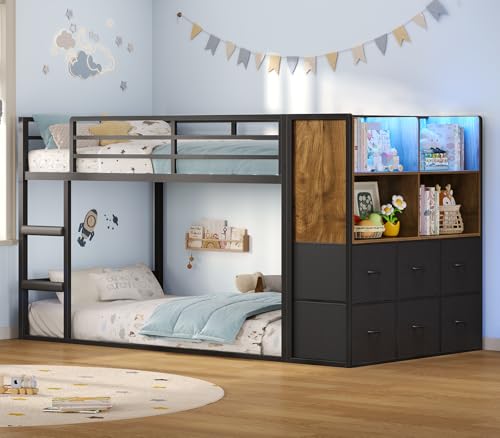
- 48.5-inch low-bunk height
- Six drawers, shelves, and RGB LED lights
- 440-pound capacity with enclosed guardrails
Best For: Children’s rooms needing both low-profile sleeping space and substantial storage
Best Low Wood Option
Gray Floor-Style Twin Bunk Bed

- 46.5-inch low-profile height
- Solid wood frame with 400-lb capacity
- Convertible lower bed for play or storage
Best For: Low-ceiling children’s rooms needing two twin beds
Best Metal Frame

- 53.94-inch overall height
- Metal frame supports up to 400 pounds
- Anti-tip devices and full-length guardrails
Best For: Compact shared rooms, dorms, and apartments
Best Flexible Layout
JOYMOR Gray Pine Twin Bunk Bed

- 47.64-inch low-profile height
- Reversible ladder fits different layouts
- Solid pine construction with 264.5-lb capacity
Best For: Children’s rooms needing flexible ladder placement
Feature-Rich Low-Profile Pick
Metal Twin Over Twin with Storage

- 54-inch low-profile height
- Storage stairs with drawers and shelves
- Built-in outlets, USB ports, and RGB lights
Best For: Kids’ rooms needing low height and integrated storage
Simple Wood Space Saver

- 47.64-inch height for very low ceilings
- Solid pine frame with hardwood slats
- Reversible ladder and full-length guardrails
Best For: Small children’s rooms needing the lowest-profile option
Sturdy Safety-Focused Choice

- 51-inch height for lower ceilings
- 350-pound upper-bunk capacity
- Integrated ladder and 12-inch guardrails
Best For: Families wanting a sturdy low wooden bunk for kids or teens
Best Overall Low Bunk – Max & Lily Fundamental Twin in Pecan
For shoppers comparing bunk beds for low ceilings, this Max & Lily twin-over-twin model is a strong all-around option. Its 49.25-inch height, solid-wood construction, and streamlined lower bunk help preserve headroom while making the bottom bed easier to access.
Best For: Families wanting a low-profile wooden bunk bed with a simple, durable design.
Pros:
- Low 49.25-inch profile helps maximize headroom.
- Solid wood frame with non-toxic finishes.
- 14-inch guardrails and strong slats support safer, stable use.
- Supports up to 400 pounds and needs no box spring.
Cons:
- The twin-over-twin layout offers no built-in storage.
- A 5- to 8-inch mattress is recommended for the best guardrail fit.
Its compact height and easy-entry lower bunk make it especially practical for rooms where ceiling clearance and everyday bed access matter. The pecan finish also adds a warm, modern look without adding visual bulk.
Best Metal Value – Zevemomo Low-Profile Twin Bunk Bed
This Zevemomo metal bunk bed is designed with low ceilings and compact rooms in mind. Its 54.09-inch height, side ladders, reinforced slats, and full-length upper guardrail provide a practical setup for families who prefer a metal frame.
Best For: Budget-conscious families wanting a flexible, low-profile metal bunk bed.
Pros:
- Low-profile design is specifically suited to small spaces and low ceilings.
- Side ladders allow more flexible placement.
- Metal frame includes 22 reinforced slats and anti-rust powder coating.
- Upper and lower bunks support up to 350 and 400 pounds, respectively.
Cons:
- The 54.09-inch height is taller than the lowest wooden options here.
- Its metal construction may offer a less traditional look than wood.
With no box spring required and assembly tools included, this model emphasizes straightforward setup and space efficiency. Non-marring foot pads and a slat-lock design are useful touches for minimizing floor marks and sleep noise.
Best Wooden Low-Profile Pick – Max & Lily Twin Bunk Bed in White
For bunk beds for low ceilings with a clean, bright finish, the white Max & Lily Fundamental keeps the same compact 49.25-inch profile as the pecan version. Its pine-wood frame, simplified headboards, and open lower-bunk access suit shared children’s rooms where space and usability are priorities.
Best For: Families seeking a low wooden bunk bed that fits a light, modern room scheme.
Pros:
- 49.25-inch height preserves overhead clearance.
- Painted pine wood has a low-VOC, non-toxic finish.
- 14-inch guardrails and metal-supported slats add stability.
- No box spring or bunkie board is required.
Cons:
- It does not include drawers, shelves, or other storage.
- The recommended mattress range is limited to 5 to 8 inches for the best fit.
This is a good choice when you want the feel of a solid wooden bed without a tall, imposing frame. The white finish can also help a small room feel brighter while the streamlined lower bunk keeps entry simple.
Best Storage Features – BTHFST Low Twin Bunk with Drawers
This BTHFST low bunk combines sleeping space with storage and lighting, making it a useful option for compact rooms with low ceilings. At 48.5 inches high, it includes six drawers, two-tier shelves, and RGB LED lights while retaining a twin-over-twin layout.
Best For: Kids’ rooms that need built-in organization, reading light, and a low bunk profile.
Pros:
- 48.5-inch height is among the lowest options listed.
- Six storage drawers and two-tier shelves help organize toys and belongings.
- RGB LED lighting offers adjustable colors and modes through a remote or app.
- 13.8-inch enclosed guardrails, anti-tipping hardware, and a 440-pound capacity support stability.
Cons:
- The 91.2-inch length may require more floor space than simpler bunk frames.
- The added storage and lighting create a more feature-heavy design.
- Assembly is required.
This model is compelling when reducing clutter is as important as preserving ceiling clearance. Its storage-heavy design can free floor space, while the integrated lights add functionality for reading or play.
Best Low Wood Option – Gray Floor-Style Twin Bunk Bed
For shoppers comparing bunk beds for low ceilings, this floor-style twin-over-twin model stands out with an overall height of just 46.5 inches. Its solid wood frame, full-length guardrails, and built-in ladder create a compact sleeping setup for children while preserving useful floor space.
Best For: Families needing two twin beds in a low-ceiling room or shared children’s bedroom.
Pros:
- Very low 46.5-inch overall height helps reduce ceiling clearance concerns.
- Solid wood construction, 14 slats, and a stated 400-pound maximum capacity.
- 13.4-inch full-length guardrails and a three-step wide ladder add practical safety features.
- Convertible lower bed can be used for sleeping, play, or storage.
Cons:
- The gray painted finish may not suit every bedroom style.
- Assembly is required, despite the included hardware and instructions.
With the lowest listed height among these options, this is a particularly strong fit when ceiling clearance is the main concern. Its convertible lower-bed design also adds flexibility beyond a standard bunk arrangement.
Best Metal Frame – Heavy-Duty Low Twin Bunk Bed
This metal twin-over-twin bed is a practical choice for rooms with lower ceilings, thanks to its 53.94-inch overall height. It combines a compact footprint with full-length upper guardrails, an integrated ladder, and stability features intended for everyday use.
Best For: Kids’ rooms, shared bedrooms, dorms, or apartments where a metal frame and compact footprint are priorities.
Pros:
- 53.94-inch height keeps the upper bunk lower than traditional bunk beds.
- Heavy-duty metal frame and multiple support slats provide everyday support.
- Full-length 16.14-inch guardrails help create a more secure upper bunk.
- Includes anti-tip devices, non-slip foot pads, and slat-fixing buckles.
Cons:
- The metal frame may offer a less traditional look than a wooden bunk bed.
- Wall attachment is part of the stability design, so placement may require securing the bed.
This model offers a useful balance of low-profile sizing and metal-frame durability. Its anti-tip hardware and floor-protection details are notable if stability is a priority, while the vertical ladder keeps the footprint compact.
Best Flexible Layout – JOYMOR Gray Pine Twin Bunk Bed
Among bunk beds for low ceilings, this JOYMOR solid pine model offers a 47.64-inch overall height and a reversible ladder that can be installed on either side. That layout flexibility makes it easier to adapt the bed to a small children’s room while keeping the twin-over-twin configuration straightforward.
Best For: Children’s bedrooms where a low profile, wooden construction, and flexible ladder placement are important.
Pros:
- Low-profile 47.64-inch height suits rooms with lower ceilings.
- Solid pine frame and hardwood slats support up to 264.5 pounds.
- Reversible ladder can be installed on either side for different room layouts.
- Full-length 11-inch guardrails and no-box-spring design simplify setup.
Cons:
- Its 264.5-pound maximum capacity is lower than the other listed models.
- A 4- to 6-inch mattress is recommended, and mattresses are not included.
- Assembly is required.
The reversible ladder is the key advantage for rooms where furniture placement is constrained. It is also one of the shortest options listed, though shoppers should pay close attention to its lower stated weight capacity and mattress guidance.
Feature-Rich Low-Profile Pick – Metal Twin Over Twin with Storage
If you need bunk beds for low ceilings but also want built-in organization, this 54-inch-tall metal frame combines a compact profile with storage stairs, shelves, drawers, charging ports, and RGB lighting. Its twin-over-twin layout is designed to use vertical space efficiently without reaching the height of a standard bunk bed.
Best For: Kids’ rooms, apartments, or dorms where low height and integrated storage are priorities.
Pros:
- 54-inch height suits rooms with limited ceiling clearance.
- Storage stairs include pull-out drawers and side shelves.
- Built-in station provides two AC outlets, USB-A, and USB-C ports.
- Full-length upper guardrails, reinforced slats, and an anti-tip device support safer use.
Cons:
- The 108-pound frame and 94-inch length may require careful planning during assembly and placement.
- RGB lighting and the charging station may be unnecessary if you prefer a simpler bunk bed.
Choose this model when storage and built-in features matter as much as ceiling clearance. The metal construction and 600-pound maximum weight recommendation add useful capacity, while the stairs avoid relying on a narrow ladder for access.
Simple Wood Space Saver – JOYMOR Low Twin Over Twin
For shoppers seeking bunk beds for low ceilings without extra electronics or storage features, this JOYMOR twin-over-twin frame keeps the design straightforward. At 47.64 inches high, it is the shortest option in this roundup and uses a solid pine frame with a reversible ladder for flexible room placement.
Best For: Small children’s rooms with especially limited ceiling clearance and a preference for a traditional wood design.
Pros:
- 47.64-inch height is well suited to low-ceiling rooms.
- Solid pine construction and hardwood slats provide everyday support.
- Full-length 11-inch upper guardrails add protection.
- Reversible ladder can be installed on either side.
Cons:
- Its 264.5-pound maximum load is lower than the other listed models.
- Mattresses are not included, and a 4- to 6-inch mattress is recommended.
This is a practical choice when low height is the main requirement. The clean wooden design, standard Twin mattress compatibility, and included assembly hardware keep the setup relatively uncomplicated, while the side-switchable ladder helps it fit different layouts.
Sturdy Safety-Focused Choice – KOMFOTT 51-Inch Low Bunk
This KOMFOTT twin-over-twin frame is a strong middle ground for bunk beds for low ceilings, standing 51 inches high while supporting up to 350 pounds on the upper bunk. Its solid pine and plywood construction, full-length guardrails, and integrated two-step ladder provide a compact setup for children or teens.
Best For: Families wanting a low wooden bunk with a higher stated capacity and built-in climbing access.
Pros:
- 51-inch design helps preserve clearance in rooms with lower ceilings.
- Solid pine frame and reinforced screw connections support stability.
- 12-inch full-length guardrails and a smooth-edged integrated ladder emphasize safety.
- 14+7 plywood slats support mattresses without a box spring and are designed for quieter use.
Cons:
- Mattresses are not included and should be no more than 6 inches thick.
- The lower bed’s listed dimensions and 43.5-inch depth may need careful room planning.
Consider this model if you want a low profile without giving up a sturdier capacity rating. Its clean gray finish fits several room styles, and the built-in ladder avoids the need to position a separate access piece.
How We Picked the Best Bunk Beds for Low Ceilings
We focused on features that matter most in rooms with limited vertical clearance: low-profile construction, practical access to the upper bunk, substantial guardrails, stable frames, and space-efficient layouts. The selection includes solid-wood and metal designs, as well as models with drawers, shelves, stairs, lighting, or other built-in storage.
We also considered whether a bed requires a box spring, how clearly the frame communicates mattress compatibility, and whether its design is better suited to young children, older kids, or teens. Always verify the manufacturer’s dimensions and weight limits before ordering.
Quick Comparison
Solid-wood low bunk beds generally offer a warm appearance and sturdy feel, while metal frames can provide a slimmer profile and higher weight capacity. Basic twin-over-twin models are usually the easiest to fit into a small room. Storage stairs, drawers, shelves, and lighting add convenience but may increase the bed’s footprint and assembly complexity.
Before comparing finishes or extras, measure the room and identify the maximum safe overall height. A low frame is helpful, but the mattress and sleeper still need adequate clearance from the ceiling.
Key Buying Factors for Bunk Beds for Low Ceilings
Overall Height and Ceiling Clearance
Measure from the floor to the ceiling, then account for the mattress thickness. The upper sleeper needs enough room to sit, turn, and get in and out safely. Avoid relying only on a product title that says “low”; check the complete assembled dimensions.
Guardrails and Ladder Access
Look for a full-length upper guardrail and a ladder that is firmly integrated with the frame. Wide, well-spaced steps or rungs can make daily use easier, while a ladder position should leave enough clearance for nearby furniture and doors.
Frame Construction and Weight Capacity
Solid wood can provide a substantial, classic structure; metal may offer a lighter visual profile and strong support. Review the stated weight limits for each bunk, including the sleeper and mattress, and check whether the manufacturer recommends anchoring the bed to a wall.
Mattress Support and Safety
Many bunk beds use slats and do not need a box spring, but mattress thickness limits still matter. Use the recommended mattress size and thickness, tighten hardware after assembly, and inspect connections periodically. Follow the manufacturer’s age and safety guidance for upper-bunk use.
Storage, Lighting, and Room Layout
Drawers, shelves, stairs, outlets, and LED lights can be useful in a shared room, but measure the clearance needed to open drawers or access shelves. Keep cords away from ladders and sleeping areas, and avoid letting accessories compromise safe movement around the bed.
Who Should Buy Which Bunk Beds for Low Ceilings?
Choose a simple low twin-over-twin frame if ceiling clearance and affordability are your priorities. A solid-wood model suits buyers who want a traditional look and substantial construction. A metal low-profile bed may be preferable for a cleaner, lighter appearance or a higher listed capacity. Families short on closet space should consider drawers or storage stairs, provided the added footprint fits the room. For younger children, prioritize the lowest practical design, secure guardrails, easy ladder access, and strict adherence to the manufacturer’s safety instructions.