The best belt sanders for woodworking remove material quickly, flatten rough boards, and prepare surfaces for finer sanding. The right model depends on your projects, preferred working style, power source, and dust-control needs.
We compared 10 popular options, from compact 3-by-21-inch handheld sanders to powerful 4-by-24-inch and benchtop machines, so you can choose confidently for furniture, cabinetry, flooring, and general shop work.
Best 10 Belt Sanders for Woodworking Picks for 2026
Fast Flush-Cutting Power
Makita 9403 4" x 24" Belt Sander

- 4-inch belt removes material quickly at 1,640 ft./min.
- Designed for sanding flush to walls
- Low-noise 84 dB operation
Best For: Large surfaces and flush-to-wall sanding
Cordless Jobsite Control

- Brushless cordless motor for portable work
- 25-speed dial supports precise adjustments
- Tool-free belt changes and dust collection compatibility
Best For: Mobile woodworking and jobsite sanding
Variable-Speed Wall Sanding
Makita 9903 3" x 21" Belt Sander

- 690–1,440 ft./min. variable-speed control
- Auto-tracking belt system needs no adjustment
- Flush-sanding design and 9.5-pound weight
Best For: Controlled sanding near walls and moderate-size surfaces
Handheld-to-Benchtop Flexibility

- Converts to an upward-facing benchtop sander
- 10-amp motor with variable speed
- Includes clamps, pad, dust bag, and two belts
Best For: DIY workshops needing handheld and stationary sanding
Best Pressure-Control Pick

- Pressure-control warning helps prevent excessive force
- Auto belt tracking keeps the belt centered
- Flush-edge sanding and vacuum compatibility
Best For: DIY woodworkers prioritizing control and edge sanding
Best Benchtop Two-in-One
WEN 4 x 36-Inch Belt and Disc Sander
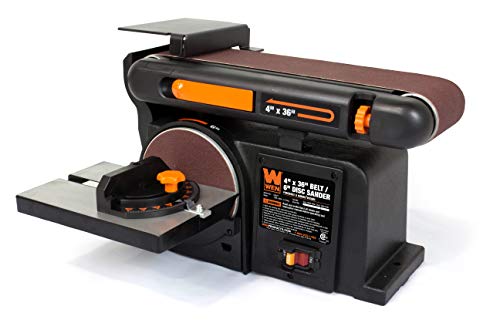
- Combines a 4-by-36-inch belt with a 6-inch disc
- Tilting belt adjusts from 0 to 90 degrees
- Cast-iron base helps reduce vibration
Best For: Workshop users needing stationary belt and disc sanding
Best Fast Material Removal
CRAFTSMAN 7 Amp 3 x 21-Inch Belt Sander

- 7-amp motor provides up to 800 fpm
- Angled belt sands closer to adjoining surfaces
- Tool-free belt release and three-position handle
Best For: Handheld users focused on fast stock removal
Most Versatile Pick
Jellas 7-Amp Variable-Speed Belt Sander

- Six-dial variable-speed control
- Includes 10 belts from 40 to 180 grit
- Converts for bench-sanding use
Best For: Flexible woodworking setups and varied sanding tasks
Best Variable-Speed Value
WEN HB321V 7.5-Amp Belt Sander

- 620–1200 feet-per-minute variable speed
- Lightweight 6.4-pound design
- Quick-release belt tension lever
Best For: Lightweight handheld sanding with adjustable speed
Best Simple Workhorse
WEN 6321 7-Amp Corded Belt Sander
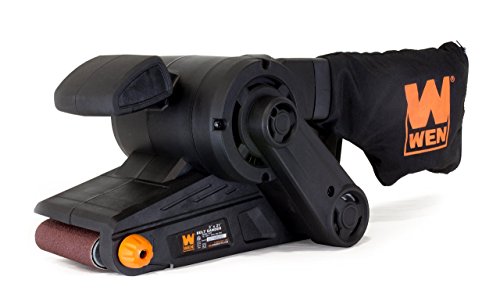
- 7-amp motor runs over 13 feet per second
- Lightweight design helps reduce fatigue
- Lock-in switch supports continuous sanding
Best For: Straightforward general-purpose woodworking
Fast Flush-Cutting Power – Makita 9403 4" x 24" Belt Sander
For demanding woodworking jobs, the Makita 9403 is a high-capacity choice among belt sanders for woodworking. Its 4-inch-wide belt runs at 1,640 feet per minute for fast stock removal, while the low-noise 84 dB operation is designed to improve operator comfort.
Best For: Quickly smoothing large wood surfaces and sanding close to walls.
Pros:
- 4-inch belt and 1,640 ft./min. speed support rapid material removal.
- Flush-sanding design reaches walls with the sander’s nose and side.
- Labyrinth construction helps protect the motor and bearings from dust.
- Large front grip and relatively low 84 dB noise support comfortable operation.
Cons:
- At 13 pounds, it is heavier than the smaller Makita 9903.
- Corded operation limits portability.
- It includes an 80-grit belt, so additional grits may be needed for finishing work.
The 9403 is best suited to users who prioritize fast, broad sanding and flush-wall capability over low weight or cordless convenience.
Cordless Jobsite Control – DEWALT 20V MAX Belt Sander
The DEWALT DCW220B brings cordless flexibility to belt sanders for woodworking, with a brushless motor, variable-speed control, and a tool-free belt-change system. It is sold as a tool only, so a compatible 20V MAX battery and charger are required.
Best For: Cordless sanding on demanding jobs where speed control and dust collection matter.
Pros:
- Brushless 20V MAX motor is designed for power and runtime.
- 25-speed selection dial helps match belt speed to the application.
- Tool-free quick-release system simplifies sanding belt changes.
- Compatible dust collection system is rated for up to 95% collection efficiency.
Cons:
- Battery and charger are not included.
- The compatible DEWALT AirLock dust-collection system is sold separately.
- Its 16-ounce listed weight may not represent the weight with a battery installed.
Choose this model when mobility and adjustable control outweigh the need for a ready-to-use corded setup. Its two-handed auxiliary handle also suits longer, demanding sanding sessions.
Variable-Speed Wall Sanding – Makita 9903 3" x 21" Belt Sander
The Makita 9903 is a lighter corded option among belt sanders for woodworking, combining an 8.8-amp motor with variable speed from 690 to 1,440 feet per minute. Its auto-tracking belt system and flush-sanding design reduce adjustment demands during detail-oriented work.
Best For: Woodworkers who want adjustable speed, easier handling, and controlled sanding near walls.
Pros:
- Variable-speed dial helps match sanding speed to the application.
- Auto-tracking belt system keeps the belt aligned without adjustment.
- Flush-sanding design reaches close to walls with the nose and side.
- At 9.5 pounds, it is relatively manageable for a corded belt sander.
Cons:
- The 3-inch belt is narrower than the Makita 9403’s 4-inch belt.
- Corded 110V operation limits portability.
- Only one belt is included.
The 9903 offers a practical balance of control and handling for users who do not need the widest sanding surface but still want strong corded performance and flush access.
Handheld-to-Benchtop Flexibility – WEN HB424V Belt Sander
WEN 10-Amp 4-by-24-Inch Variable Speed Combination Handheld and Benchtop Belt Sander (HB424V)
Check Price On AmazonThe WEN HB424V stands out among belt sanders for woodworking because it can work handheld or attach to a benchtop as an upward-facing stationary sander. Its 10-amp variable-speed motor, lock-on switch, and included mounting hardware make it a versatile workshop option.
Best For: DIY woodworkers who want one belt sander for handheld and benchtop use.
Pros:
- Converts from handheld to benchtop operation with the included mounting accessories.
- Variable speed ranges from 660 to 1,310 ft./min.
- Lock-on switch supports continuous sanding without holding the trigger.
- Includes two 80-grit belts, a dust bag, mounting clamps, and a two-year warranty.
Cons:
- Its combination design may be less specialized than a dedicated sander.
- The included sanding accessories are limited primarily to 80-grit belts.
- Corded 120V operation requires access to an outlet.
For a home workshop, the HB424V’s conversion capability provides useful flexibility: use it on large surfaces by hand, then mount it for repeatable stationary sanding tasks.
Best Pressure-Control Pick – SKIL 6 Amp 3"x18" Belt Sander
For woodworkers who want a handheld option with feedback during use, this SKIL is one of the more approachable belt sanders for woodworking. Its 6-amp motor, pressure-control technology, automatic belt tracking, and flush-edge capability cover common stock-removal and edge-sanding tasks.
Best For: DIY woodworkers who want pressure feedback, centered belt tracking, and vacuum compatibility.
Pros:
- Pressure-control technology warns when excessive pressure is applied.
- 6-amp motor is designed to sand a variety of wood surfaces.
- Auto track keeps the belt centered, while flush-edge sanding reaches close to edges.
- Micro-filtration and compatibility with standard 1-1/4-inch vacuum hoses support dust management.
Cons:
- Corded operation requires access to a 120-volt outlet.
- The 3-by-18-inch belt format offers less sanding width than some larger machines.
This is a practical all-around choice when control and edge access matter more than cordless convenience or benchtop versatility.
Best Benchtop Two-in-One – WEN 4 x 36-Inch Belt and Disc Sander
WEN Benchtop Belt and Disc Sander with 4 x 36 in. Belt, 6 in. Disc and Cast Iron Base (6502T)
Check Price On AmazonThis WEN combines belt and disc sanding in one benchtop machine, making it a versatile choice among belt sanders for woodworking. Its 4-by-36-inch belt, 6-inch disc, tilting belt, and cast-iron base support varied stationary sanding tasks.
Best For: Workshop users who want both belt and disc sanding in a stable benchtop setup.
Pros:
- Two-in-one design includes a 4-by-36-inch belt and 6-inch disc.
- Belt tilts from 0 to 90 degrees for angled sanding.
- Cast-iron base helps limit heavy vibrations.
- Tension-release lever simplifies abrasive changes.
Cons:
- Its benchtop form requires dedicated workspace.
- The 4.3-amp motor is less powerful on paper than the handheld models in this roundup.
- It is corded and requires a 120-volt power source.
Choose this model when stationary stability and the ability to switch between belt and disc sanding are more useful than portability.
Best Fast Material Removal – CRAFTSMAN 7 Amp 3 x 21-Inch Belt Sander
With a 7-amp motor and a maximum belt speed of 800 feet per minute, this CRAFTSMAN is aimed at quick stock removal. For belt sanders for woodworking, its angled belt design, tool-free belt release, adjustable handle, and included dust bag add useful convenience for handheld work.
Best For: Woodworkers who want fast material removal and a comfortable handheld design.
Pros:
- 7-amp motor and up to 800 fpm support fast material removal.
- Angled belt design helps sand closer to adjoining surfaces.
- Tool-free belt release makes belt changes easier.
- Three-position over-molded handle and an onboard dust bag improve usability.
Cons:
- Corded operation limits mobility to areas with power access.
- It lacks the supplied pressure-warning feature of the SKIL model.
This is a strong fit for users who value speed and close-to-surface sanding, provided a corded handheld tool suits the workspace.
Most Versatile Pick – Jellas 7-Amp Variable-Speed Belt Sander
For shoppers comparing belt sanders for woodworking, the Jellas combines a 7-amp motor with six variable-speed settings and a useful bench-sander setup. Its included sanding belts and flexible dust-collection options make it adaptable for a range of projects.
Best For: Woodworkers who want variable speed, included grits, and the option to use the tool as a bench sander.
Pros:
- Six-dial variable-speed control helps match sanding speed to the application.
- Includes 10 aluminum oxide belts ranging from 40 to 180 grit.
- Can be clamped upside down for bench-sanding use.
- Supports both a detachable dust bag and 32mm or 35mm vacuum adapters.
Cons:
- The included setup has more accessories and adjustments than a basic belt sander.
- Its 7-amp motor is slightly less powerful than the 7.5-amp WEN variable-speed model.
The Jellas stands out when versatility matters more than a bare-bones design. Variable speed, a 10-foot cord, multiple belts, and bench-sanding capability give it broad utility for woodworking tasks.
Best Variable-Speed Value – WEN HB321V 7.5-Amp Belt Sander
WEN 7.5-Amp 3-by-21-Inch Variable Speed Handheld Portable Belt Sander (HB321V)
Check Price On AmazonThe WEN HB321V is a practical choice among belt sanders for woodworking when you want adjustable belt speed without a heavy tool. Its 7.5-amp motor, quick belt changes, and dust-collection options suit routine stock removal and surface preparation.
Best For: Woodworkers seeking a lightweight variable-speed sander with straightforward belt changes.
Pros:
- Variable-speed motor operates from 620 to 1200 feet per minute.
- At 6.4 pounds, the compact design helps limit user fatigue.
- Quick-release tension lever simplifies sandpaper installation and grit changes.
- Includes a detachable dust bag, 1-1/4-inch dust port, and 80-grit belt.
Cons:
- Only one 80-grit sanding belt is included.
- It lacks the supplied multi-grit belt assortment and bench-sanding clamps found with the Jellas.
The HB321V offers a strong balance of power, speed control, and manageable weight. It is especially appealing if you prefer a compact handheld tool and plan to choose additional sanding belts separately.
Best Simple Workhorse – WEN 6321 7-Amp Corded Belt Sander
If you want uncomplicated belt sanders for woodworking, the WEN 6321 focuses on the essentials: a 7-amp motor, a 3-by-21-inch belt, a lock-in switch, and a detachable dust bag. Its compact six-pound design is suited to everyday sanding without extra controls.
Best For: Budget-conscious woodworkers who want a straightforward corded belt sander for general-purpose work.
Pros:
- 7-amp motor drives the belt at over 13 feet per second.
- Compact design weighs about six pounds to help reduce fatigue.
- Lock-in safety feature supports continuous sanding without holding the trigger.
- Includes a detachable dust bag and two-year warranty.
Cons:
- It does not offer variable-speed control.
- The supplied package includes a dust bag but no multi-grit belt assortment.
The WEN 6321 is a sensible pick when reliable core functions matter more than speed adjustment or accessories. Its light body and lock-in switch make it easy to use for sustained handheld sanding.
How We Picked the Best Belt Sanders for Woodworking
We focused on the specifications and features that most affect real woodworking performance: belt size, motor output, speed control, handling, dust collection, portability, and overall versatility. The lineup includes corded and cordless handheld models as well as benchtop sanders, giving different types of woodworkers practical options.
We also considered whether each sander is better suited to aggressive stock removal, controlled finishing, edge work, or repeatable small-part shaping. A higher amp rating can indicate greater power, but balance, tracking, pressure control, and comfortable operation matter just as much.
Quick Comparison
| Best For | Recommended Type | What to Look For |
|---|---|---|
| Fast material removal | 4-by-24-inch corded model | High power, wide belt, stable tracking |
| Portable jobsite work | 20V cordless model | Battery compatibility, variable speed, dust collection |
| General woodworking | 3-by-21-inch handheld model | Manageable weight, easy belt changes, good control |
| Small parts and repeatable shaping | Benchtop belt or belt-and-disc sander | Rigid base, adjustable tables, compact footprint |
Key Buying Factors for Belt Sanders for Woodworking
Belt Size and Sanding Speed
A 3-by-21-inch belt is a versatile choice for furniture parts, boards, and general repairs. Larger 4-by-24-inch belts cover more surface and are useful for flattening wide stock, but they can feel heavier and less nimble. Consider variable speed if you work with different wood species or need more control near edges.
Power and Power Source
Corded sanders provide consistent output for long shop sessions and are usually the best choice for heavy stock removal. Cordless models offer easier movement and avoid extension cords, but battery runtime, pack weight, and the cost of batteries can affect total value.
Handling, Tracking, and Pressure Control
Look for balanced ergonomics, comfortable handles, reliable belt tracking, and features that help prevent gouging. Pressure-control systems can be especially useful for beginners because they encourage a more even sanding approach. A lighter model may be preferable for vertical surfaces or overhead work.
Dust Collection and Workspace Needs
Dust bags are convenient for quick jobs, while vacuum adapters can provide better collection in a workshop. No belt sander captures every particle, so wear eye and respiratory protection and use suitable ventilation or shop-vac filtration.
Who Should Buy Which Belt Sanders for Woodworking?
Choose a powerful 4-by-24-inch corded sander if you regularly flatten large boards or need rapid material removal. A 3-by-21-inch handheld model is the most practical all-around option for many DIYers and furniture makers. Choose a cordless DEWALT option when mobility is more important than uninterrupted runtime.
Benchtop models make the most sense for woodworkers shaping smaller components, sanding edges, or combining belt and disc functions in a compact station. If you are new to belt sanding, prioritize manageable weight, variable speed, dust collection, and comfortable controls over maximum motor power.