Furniture refinishing often begins with a demanding job: removing old paint, finish, or uneven wood without creating more repair work. The right belt sander can speed up that process while giving you enough control to protect edges and preserve useful details.
This roundup compares 10 leading options, including compact handheld sanders, cordless models, and belt-disc combinations for workshop use. Use the buying guide below to match sanding power, control, dust handling, and machine size to your projects.
Best 10 Belt Sanders for Furniture Refinishing Picks for 2026
Best Variable-Speed Choice
Makita 9903 3" x 21" Belt Sander

- Powerful 8.8-amp motor
- Variable speed from 690 to 1,440 feet per minute
- Auto-tracking belt and flush-sanding design
Best For: Controlled sanding on furniture and flush edge work
Best Lightweight Value
WEN HB321V Variable-Speed Belt Sander

- Lightweight 6.4-pound design
- Variable speed from 620 to 1,200 feet per minute
- Includes dust bag, dust port, and 80-grit belt
Best For: DIY refinishing and users who want reduced fatigue
Best Cordless Option
DEWALT 20V MAX XR Cordless Belt Sander

- Brushless 20V MAX cordless motor
- 25-speed selection dial for control
- Quick-release belt and dust-collection compatibility
Best For: Mobile refinishing and larger jobs without a power cord
Best Pressure-Control Design
SKIL 7510-01 3" x 18" Belt Sander

- Pressure-control warning helps prevent excessive force
- Micro-filtration captures fine dust particles
- Auto-tracking belt and flush-edge sanding
Best For: Controlled wood refinishing and edge work
Compact Workshop Pick
WEN 4 x 36-Inch Belt and 6-Inch Disc Sander
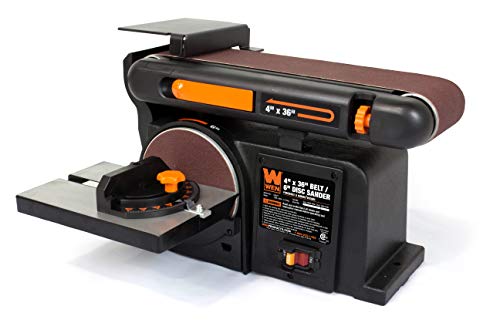
- 4-by-36-inch belt plus 6-inch disc
- 0–90-degree belt adjustment
- Cast iron base helps limit vibration
Best For: Home workshops handling furniture parts, edges, and general woodworking
Adjustable Value Option
Woodskil 4.3A Belt and Disc Sander

- 3/4-horsepower motor with 1,732 FPM belt speed
- 0–90-degree belt and 0–45-degree table adjustment
- Dual dust ports and included miter gauge
Best For: Angle-sensitive furniture shaping and contour sanding
Heavy-Duty Furniture Shop Choice

- 800W motor with 6-by-48-inch belt and 9-inch disc
- Includes heavy-duty open stand
- 0–90-degree belt and 0–45-degree disc-table adjustment
Best For: Larger furniture, cabinet work, and dedicated workshops
Powerful Bench Combo
Woodskil 4.5A Belt Disc Sander

- 3/4HP motor with 1900 FPM belt speed
- Adjustable belt and tilting worktables
- Includes miter gauge and quick belt change
Best For: Furniture edges, contours, and bevel sanding
Stable Multi-Angle Choice
VEVOR 2 x 42-Inch Belt Disc Sander

- 420W motor with adjustable sanding arm
- Tilting tables and included miter gauge
- Metal base, rubber feet, and dust port
Best For: Stable furniture, cabinet, and panel refinishing
Best Simple Pick
VEVOR 4 x 36-Inch Belt Disc Sander
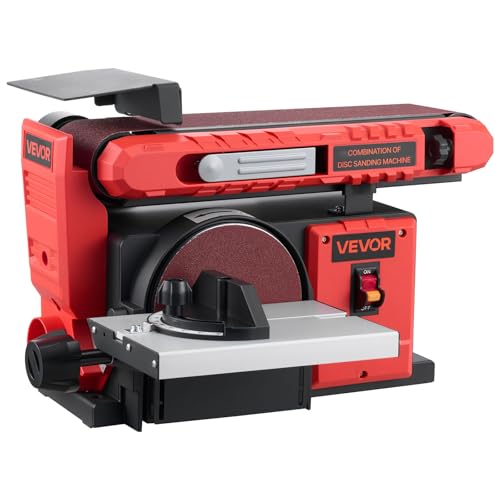
- 400W motor with 4 x 36-inch sanding belt
- Belt adjusts horizontally or vertically
- Compact frame with tilting table and dust port
Best For: DIY furniture and cabinet refinishing in home workshops
Best Variable-Speed Choice – Makita 9903 3" x 21" Belt Sander
For furniture refinishing projects that call for controlled material removal, the Makita 9903 combines an 8.8-amp motor with a variable-speed dial from 690 to 1,440 feet per minute. Its auto-tracking belt system and flush-sanding design make it a practical option among belt sanders for furniture refinishing.
Best For: Refinishing furniture where variable speed, belt tracking, and flush edge access matter.
Pros:
- Powerful 8.8-amp motor for demanding sanding work
- Variable-speed control helps match sanding speed to the application
- Auto-tracking belt system requires no adjustment
- Designed for sanding flush to walls with the nose and side
Cons:
- At 9.5 pounds, it is heavier than some compact options
- Corded operation requires access to a power outlet
- Includes one 80-grit belt, limiting the included grit selection
The Makita is a well-equipped corded choice for larger refinishing tasks. Its combination of power, speed control, and tracking support is especially useful when consistent sanding control is more important than minimizing tool weight.
Best Lightweight Value – WEN HB321V Variable-Speed Belt Sander
WEN 7.5-Amp 3-by-21-Inch Variable Speed Handheld Portable Belt Sander (HB321V)
Check Price On AmazonThe WEN HB321V is a practical entry point for belt sanders for furniture refinishing, offering a 7.5-amp variable-speed motor in a 6.4-pound body. Its lock-on switch, quick-release belt lever, and included dust bag support straightforward project work.
Best For: DIY furniture refinishing where low weight, variable speed, and easy belt changes are priorities.
Pros:
- Lightweight 6.4-pound design helps limit user fatigue
- Variable-speed motor adjusts from 620 to 1,200 feet per minute
- Quick-release lever simplifies sandpaper installation and grit changes
- Includes a detachable dust bag, 1-1/4-inch dust port, and 80-grit belt
Cons:
- Its 7.5-amp motor is less powerful than the Makita’s 8.8-amp motor
- Only one 80-grit sanding belt is included
- Corded operation limits mobility
With its lighter body and useful speed range, the WEN is suited to users who want a manageable tool for furniture projects. The included dust-collection options and two-year warranty add practical value for occasional refinishing.
Best Cordless Option – DEWALT 20V MAX XR Cordless Belt Sander
The DEWALT DCW220B brings cordless convenience to belt sanders for furniture refinishing with a brushless 20V MAX motor and variable-speed control. It is a tool-only kit, but it supports quick belt changes, two-handed handling, and compatible dust-collection systems.
Best For: Large refinishing jobs and mobile work where cordless operation and dust collection are important.
Pros:
- Brushless motor is designed for efficiency and runtime
- Variable-speed trigger and 25-speed selection dial support precise control
- Tool-free quick-release system speeds up belt changes
- Compatible dust-collection setup is rated for up to 95% collection efficiency
Cons:
- Tool-only package does not include a battery or charger
- Dust collection requires a separately sold DEWALT AirLock-compatible system for the stated setup
- Cordless battery operation adds a separate power-platform requirement
The DEWALT stands out when outlet-free mobility and jobsite performance are priorities. Its dust-collection compatibility and broad speed adjustment make it versatile, provided you already use or plan to buy compatible 20V batteries and collection equipment.
Best Pressure-Control Design – SKIL 7510-01 3" x 18" Belt Sander
The SKIL 7510-01 is designed to help prevent over-sanding during furniture projects. Its pressure-control technology warns when excessive force is applied, while micro-filtration, automatic belt tracking, and flush-edge sanding make it a practical choice among belt sanders for furniture refinishing.
Best For: Wood refinishing projects where pressure guidance, dust containment, and edge access are useful.
Pros:
- Pressure-control technology alerts you when too much force is applied
- Micro-filtration helps capture fine dust particles
- Auto-track belt alignment keeps the belt centered
- Vacuum compatibility and flush-edge sanding support cleaner, thorough work
Cons:
- Its 6-amp motor provides less power than the Makita and WEN models listed
- It is a corded tool, so mobility depends on outlet access
- No sanding belt is listed among the included components
The SKIL is a sensible option for refinishing users who value feedback while sanding. Its pressure warning and edge-sanding capability can help support more consistent results, especially for wood surfaces that require careful material removal.
Compact Workshop Pick – WEN 4 x 36-Inch Belt and 6-Inch Disc Sander
WEN Benchtop Belt and Disc Sander with 4 x 36 in. Belt, 6 in. Disc and Cast Iron Base (6502T)
Check Price On AmazonFor DIYers comparing belt sanders for furniture refinishing, the WEN 6502T offers two sanding surfaces in one benchtop machine. Its 4-by-36-inch belt handles broader surfaces, while the 6-inch disc is useful for edges, smaller pieces, and detail shaping.
Best For: Home workshops that need a compact belt-and-disc sander for furniture parts, edges, and general woodworking.
Pros:
- Combines a 4-by-36-inch belt with a 6-inch disc.
- Belt tilts from 0 to 90 degrees for horizontal or vertical sanding.
- Cast iron base helps reduce heavy vibrations during use.
- Tension release lever simplifies sandpaper changes.
Cons:
- The 4.3-amp motor is less powerful on paper than the larger 800W option in this roundup.
- Its benchtop design requires a suitable work surface rather than including a stand.
The WEN is a practical choice when versatility and a stable benchtop footprint matter more than maximum sanding capacity. It suits furniture refinishing tasks that benefit from both belt and disc access.
Adjustable Value Option – Woodskil 4.3A Belt and Disc Sander
The Woodskil combines a 4-by-36-inch belt and 6-inch disc in a flexible benchtop setup, making it a useful contender among belt sanders for furniture refinishing. Adjustable belt positioning, a tilting work table, and separate dust ports support shaping and contour work.
Best For: Furniture refinishing and woodworking projects that need adjustable sanding angles, contour control, and dust-port flexibility.
Pros:
- 3/4-horsepower motor delivers up to 3,570 RPM and 1,732 FPM.
- Belt adjusts from horizontal to vertical, from 0 to 90 degrees.
- Work table tilts from 0 to 45 degrees and includes a miter gauge.
- Separate belt and disc dust ports support vacuum connection.
Cons:
- The 25-pound benchtop design still needs a stable work surface.
- The supplied notes identify two sandpapers but do not specify a broad accessory selection.
With useful angle adjustments, dual dust exhaust, and a stated two-year warranty, the Woodskil is well suited to users who want more setup flexibility for shaping furniture components and contours.
Heavy-Duty Furniture Shop Choice – VEVOR 6 x 48-Inch Belt Sander
For larger furniture components and demanding workshop use, the VEVOR provides a 6-by-48-inch belt, 9-inch disc, and included stand. This larger-format machine is a strong option among belt sanders for furniture refinishing when added work area, stability, and multi-angle sanding are priorities.
Best For: Larger furniture panels, cabinet work, refinishing, and workshops that want a stand-mounted belt-and-disc sanding machine.
Pros:
- 800W motor powers a 6-by-48-inch belt and 9-inch disc.
- Belt arm adjusts from 0 to 90 degrees for horizontal or vertical sanding.
- Disc worktable tilts from 0 to 45 degrees and includes a miter gauge.
- Heavy-duty stand helps provide support, while the dust port allows vacuum connection.
Cons:
- At 75.8 pounds, it is substantially less portable than benchtop alternatives.
- The supplied notes list coarse 80-grit sanding material, so additional grits may be needed for finish work.
- Its larger footprint requires more workshop space.
The VEVOR emphasizes capacity and support rather than portability. Its long belt, large disc, stand, and adjustable tables make it particularly appealing for repeated furniture and cabinet sanding in a dedicated workspace.
Powerful Bench Combo – Woodskil 4.5A Belt Disc Sander
For furniture refinishing and detailed woodworking, the Woodskil combines a 4 x 36-inch belt with a 6-inch disc. Its 3/4HP direct-drive motor, adjustable belt position, and included miter gauge make it useful for edge work, contour sanding, and smaller end surfaces.
Best For: DIY woodworkers who want a versatile benchtop belt-and-disc setup for furniture edges, contours, and bevels.
Pros:
- 3/4HP direct-drive motor delivers a 1900 FPM belt speed and 3590 RPM disc speed.
- Belt arm adjusts from horizontal to vertical for different workpiece shapes.
- Tables tilt for bevel sanding, and the miter gauge supports more accurate work.
- Quick belt-change process and belt tracking help simplify maintenance.
Cons:
- At 39.6 pounds, it is relatively heavy for a benchtop tool.
- The supplied 80-grit abrasive may not cover every refinishing stage.
- It is corded and requires a 110-volt power source.
This is a strong choice when stable, multi-angle sanding matters more than portability. The belt-and-disc combination is especially practical for furniture components that need both broad edge sanding and precise end work.
Stable Multi-Angle Choice – VEVOR 2 x 42-Inch Belt Disc Sander
This VEVOR combo is a practical option among belt sanders for furniture refinishing, pairing a 2 x 42-inch belt with a 6-inch disc. Its adjustable sanding arm, tilting tables, sturdy base, and vacuum connection support controlled work on cabinets, panels, and furniture parts.
Best For: Woodworkers who prioritize angle flexibility, stability, and dust collection for refinishing projects.
Pros:
- 420W motor provides a 1250 RPM belt speed and 3590 RPM disc speed.
- Belt arm adjusts from 0 to 90 degrees for horizontal or vertical sanding.
- Belt and disc tables tilt from 0 to 45 degrees and include a miter gauge.
- Heavy-duty metal base, rubber feet, and dust port improve workshop usability.
Cons:
- The 32-pound body takes up dedicated bench space.
- The supplied 80-grit abrasive is relatively coarse for final finishing.
- It is a corded 120-volt tool rather than a portable sander.
Its combination of adjustable angles and vibration-reducing support makes it well suited to repeatable furniture work. The dust collection port is also helpful when connecting the tool to a shop vacuum during indoor refinishing.
Best Simple Pick – VEVOR 4 x 36-Inch Belt Disc Sander
For home workshops and DIY furniture projects, this VEVOR combines a 4 x 36-inch belt with a 6-inch disc in a compact benchtop design. The belt moves from horizontal to vertical, while the adjustable disc table and dust port add flexibility for shaping and refinishing.
Best For: DIYers needing a compact belt-and-disc sander for furniture, cabinets, craft projects, and general woodworking.
Pros:
- 400W motor drives the disc at 3550 RPM and the belt at 600 RPM.
- Belt adjusts from 0 to 90 degrees for horizontal and vertical sanding.
- Disc worktable tilts from 0 to 45 degrees and includes a miter gauge.
- Compact frame and dust collection port suit home workshops.
Cons:
- The listed 600 RPM belt speed is slower than the other included options.
- The supplied 60-grit abrasive is coarse for delicate finishing work.
- Its 33.7-pound weight limits easy repositioning.
This model makes sense when bench space and versatility are priorities. Its larger 4-inch belt offers useful surface area for furniture components, while the adjustable setup handles both straight edges and angled work.
How We Picked the Best Belt Sanders for Furniture Refinishing
We focused on the features that matter when preparing tables, cabinets, doors, shelves, and other wooden furniture for paint or a new finish. The selection includes handheld 3-by-21-inch and 3-by-18-inch sanders for broad surfaces, as well as benchtop belt-disc machines for smaller parts, shaping, and workshop projects.
We also considered motor output, variable-speed control, sanding-belt size, dust-collection options, pressure-control features, portability, and overall versatility. Because furniture work ranges from aggressive finish removal to controlled smoothing, no single format is ideal for every user.
Quick Comparison
- Best for portable general use: A 3-by-21-inch handheld sander balances coverage and maneuverability.
- Best for controlled sanding: Variable speed and pressure-control features help reduce gouging and overheating.
- Best for cordless work: A brushless 20V model is useful where outlets or extension cords are inconvenient.
- Best for a workshop: Belt-disc combinations provide a stable platform for smaller components and angled work.
- Best for large stock removal: Wider belts, stronger motors, and longer sanding surfaces can work faster on substantial pieces.
Key Buying Factors for Belt Sanders for Furniture Refinishing
Handheld or Benchtop Design
Handheld sanders are the more flexible choice for tabletops, cabinet sides, doors, and assembled furniture. Benchtop combinations are steadier for trim, legs, brackets, and small workpieces, but they require a dedicated workspace and safe material handling.
Power and Belt Size
Higher amperage or wattage can help with thick finishes and rapid material removal, but power is only useful when you can control it. A 3-by-21-inch belt offers a practical balance for many furniture projects, while 4-by-36-inch and 6-by-48-inch formats are better suited to stationary shop work.
Speed and Surface Control
Variable speed is valuable when working with softwoods, veneers, painted surfaces, or delicate edges. Pressure-control systems and a comfortable grip can also help prevent accidental dips and uneven sanding. Start with light pressure; the machine should do most of the work.
Dust Collection and Maintenance
Look for a dust bag, vacuum port, or dual-port arrangement that matches your extraction setup. Efficient dust collection improves visibility and reduces cleanup, although sanding furniture still requires respiratory and eye protection. Check belt-tracking adjustment, replacement-belt availability, and brush or filter access before buying.
Who Should Buy Which Belt Sanders for Furniture Refinishing?
Choose a handheld corded model if you want dependable power for furniture restoration and do not mind using an extension cord. It is generally the best all-around format for tabletops and large flat panels.
Choose a cordless model if portability is your priority or you already own compatible batteries. Keep spare batteries available for extended jobs.
Choose a benchtop belt-disc sander if you regularly make furniture parts, repair small wooden components, or need repeatable edge and angle sanding. These machines are less convenient for assembled furniture but more stable for detail work.
Whichever format you select, begin with a coarse abrasive only when substantial removal is necessary, then progress to finer grits. Test the sander on a hidden area, keep it moving, and avoid lingering on veneer or edges.