Compacted soil can limit water, air, and nutrients from reaching grass roots, leaving a lawn thin, stressed, and slow to recover. The right rolling aerator creates openings in the soil so your turf can make better use of routine watering and fertilizing.
We compared 10 manual rolling lawn aerators across core and spike designs, working width, construction, adjustability, added-weight capacity, and ease of use to help you choose a practical tool for your yard.
Best 10 Rolling Lawn Aerators Picks for 2026
Best Core-Plug Pick

- Seven hollow tines remove soil plugs
- Heavy-duty steel build with replaceable tines
- Rolling design for more controlled aeration
Best For: Repeated core aeration on compacted lawns
Best Adjustable-Handle Option
Seeutek 23-Inch Rolling Aerator
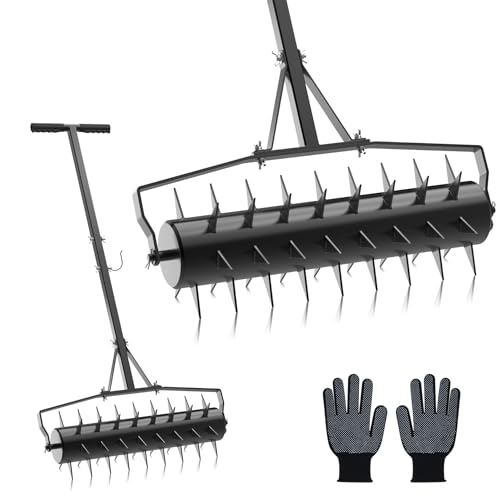
- Three adjustable handle heights
- Fillable drum adds weight for penetration
- Two-inch star-shaped spikes loosen soil
Best For: Flexible spike aeration for gardens and yards
Best Easy-Setup Value

- Pre-attached spikes simplify setup
- Add water or sand to adjust weight
- One-year warranty is included
Best For: Simple seasonal spike aeration
Best Heavy-Load Spike Roller

- Adjustable load up to 55 pounds
- Spiral spikes improve rolling control
- Auxiliary wheels ease transport
Best For: Weighted spike aeration on small to medium lawns
Long-Handle Spike Aerator

- 45 carburized spikes are built to resist bending.
- 75-inch handle minimizes bending and back strain.
- Quick-clip connections support fast, stable assembly.
Best For: Homeowners wanting long reach and quick spike aeration
Manual Coring Choice
Rolling Aerator with Soil-Plug Removal

- Rotary coring action pulls plugs from compacted soil.
- Supports improved air, water, and nutrient absorption.
- Reinforced push rod is designed for regular manual use.
Best For: Small to medium lawns needing core aeration
Stable Spiral-Tine Model
Walensee 42-Spike Rolling Lawn Aerator

- Spiral tines support smooth, stable rolling.
- 42 heat-treated spikes resist deformation.
- Adjustable handle and stone-fill weighting add flexibility.
Best For: Users wanting adjustable, weighted spike aeration
Best Weighted Manual Aerator

- Supports up to 40 pounds of added weight
- Solid, mud-resistant spikes
- Four-inch wheels for uneven terrain
Best For: Weighted manual aeration on compacted lawns and garden areas
Best for Comfortable Coverage

- 21-inch bucket with 33 spikes
- Two-inch spike depth
- Adjustable handle reduces bending
Best For: Wide manual aeration with an upright working position
Best for Adjustable Weight

- Five rotating star-shaped steel tines
- Weight tray accepts added loading
- Powder-coated steel construction
Best For: Customizable aeration on moist or loosened soil
Best Core-Plug Pick – Landzie Rolling Lawn Aerator
For gardeners who want true core removal, the Landzie is one of the more substantial rolling lawn aerators to consider. Its seven hollow stainless-steel tines pull soil plugs from compacted ground, helping air, water, and nutrients reach grass roots.
Best For: Homeowners seeking a durable manual core aerator for repeated use on compacted soil.
Pros:
- Seven hollow tines remove soil cores rather than simply puncturing the surface.
- Heavy-duty, powder-coated steel construction is designed for repeated use and rust resistance.
- Replaceable, chamfered tines are designed to eject cores and reduce clogging.
- Rolling design helps make forward-and-backward aeration more manageable.
Cons:
- Its substantial construction may feel heavy for some users.
- Core aeration generally requires more effort than simple spike aeration.
- Assembly is required before use.
The Landzie stands out when removing plugs is more important than keeping the tool exceptionally light. It is a practical choice for tougher lawns and buyers who value replaceable working parts.
Best Adjustable-Handle Option – Seeutek 23-Inch Rolling Aerator
The Seeutek combines a 23-inch rolling drum with three adjustable handle heights, making it a flexible option among rolling lawn aerators. Its star-shaped spikes can be weighted with water or sand when deeper soil penetration is needed.
Best For: Users who want adjustable handle height and customizable roller weight for garden or yard work.
Pros:
- Three handle-height settings can help accommodate different users.
- Drum can be filled with water or sand to increase spike penetration.
- Two-inch star-shaped spikes are designed to loosen compacted soil.
- Stable tripod connection and painted alloy construction support durability.
Cons:
- Spike aeration does not remove soil cores.
- Additional filling adds setup and handling considerations.
- Assembly is still required, despite the included instructions and hardware.
This Seeutek model is a sensible middle ground for buyers who prioritize ergonomic adjustment and variable weight. It is especially useful when lawn conditions change throughout the season.
Best Easy-Setup Value – Manual Roller Lawn Aerator
This manual roller lawn aerator is designed for straightforward seasonal maintenance, arriving with pre-attached spikes and an easy-assembly design. The drum accepts water or sand so users can adjust the working weight for different soil conditions.
Best For: Home users looking for a simple, economical spike aerator for seasonal lawn care.
Pros:
- Pre-attached spikes and welding-based construction simplify setup.
- Adjustable weight allows water or sand to be added to the aerator.
- Manual operation avoids fuel, batteries, or electrical connections.
- Includes a one-year warranty with free replacement for quality issues.
Cons:
- Spike aeration creates openings but does not extract soil plugs.
- The 11-pound base may need added weight for deeper penetration in hard soil.
- Product details provide less information about spike count and pattern.
With its pre-attached spikes and adjustable weight, this model emphasizes convenience over specialized core removal. It is a reasonable fit for routine seasonal use when simple manual operation is the priority.
Best Heavy-Load Spike Roller – Rolling Lawn Aerator
For small to medium-sized lawns, this rolling lawn aerator offers a heavy-duty spike approach with a 32-pound base and capacity for up to 55 pounds when loaded with sand or stones. Its spiral-spiked tread and auxiliary wheels are designed to improve control and transport.
Best For: Users who want a weighted spike aerator with easier movement between storage and the lawn.
Pros:
- Load capacity can increase total working weight to 55 pounds.
- Spiral-spiked tread is designed for smoother rolling and directional control.
- Auxiliary TPR wheels help move the unit without damaging driveways with the spikes.
- Main body arrives assembled; only the handle needs attachment.
Cons:
- The drum should be filled with sand or stones, not water.
- Heavy loading can make the tool more demanding to push and store.
- Spike aeration does not remove soil cores.
This model makes sense when added weight and portability matter more than plug extraction. The auxiliary wheels are a useful practical touch, while the high loading capacity helps adapt the tool to compacted soil.
Long-Handle Spike Aerator – 21-Inch Rolling Lawn Aerator
This 21-inch rolling lawn aerator is designed for straightforward spike aeration with a long, comfortable handle. Its 45 preassembled spikes, reinforced fastening, and quick-clip setup make it a practical option for homeowners who want to cover lawn areas without frequent bending.
Best For: Homeowners seeking a stable spike aerator with an extra-long handle and quick assembly.
Pros:
- 45 carburized spikes are designed to resist bending and deformation.
- 75-inch handle helps reduce bending and back strain.
- Gasket-supported fastening system is designed to minimize looseness during use.
- Preassembled spikes and quick-clip handle connections simplify setup.
Cons:
- Spike aeration does not remove soil plugs like a coring aerator.
- At 17.2 pounds, it may feel substantial during extended use.
Choose this model when handle reach, secure construction, and quick assembly matter most. It includes the aerator, handle, and user manual, along with a 12-month service commitment.
Manual Coring Choice – Rolling Aerator with Soil-Plug Removal
This rolling lawn aerator uses a rotary coring design to pull soil plugs from compacted ground. For small to medium lawns, its manual push operation can improve air, water, and nutrient access while providing a more intensive alternative to simple spike aeration.
Best For: Small to medium lawns that need soil-plug removal to address compaction.
Pros:
- Extracts soil plugs rather than only puncturing the surface.
- Designed to improve air, water, and nutrient absorption.
- Reinforced dual push rod supports regular manual operation.
- Patented rotary coring design promotes consistent plug pulling.
Cons:
- Manual operation requires physical effort and doubles as a workout.
- Its stated operating range is small to medium lawns.
This is the more targeted choice when relieving compaction through actual coring is the priority. Its heavy-duty construction is intended for repeated use, but users should expect more effort than with a powered tool.
Stable Spiral-Tine Model – Walensee 42-Spike Rolling Lawn Aerator
The Walensee rolling lawn aerator combines 42 heat-treated spikes with a spiral arrangement intended to keep the roller moving smoothly. Its steel construction, adjustable handle, and fillable roller let you tailor the tool for lawn conditions, provided the soil is watered and the roller is loaded with stones when extra penetration is needed.
Best For: Homeowners who want adjustable handling and a stable, weighted spike aerator.
Pros:
- Spiral tine arrangement is designed to reduce vertical jumping while rolling.
- 42 reinforced, heat-treated two-inch spikes resist deformation.
- Adjustable multi-part handle and non-slip rubber grip improve handling comfort.
- Roller can be filled with stones to increase penetration.
Cons:
- Requires thorough watering before use, especially in hard or dry soil.
- Stones are recommended for weighting; sand should not be used.
- Not recommended for hard ground, clay, root-covered areas, or gravelly soil.
This model makes sense for users who value rolling stability and adjustable height. Its performance depends on following the preparation guidance: moisten the lawn first and use stones when additional weight is needed.
Best Weighted Manual Aerator – 18-Inch VEVOR Spike Aerator
If you need rolling lawn aerators for compacted soil, this 18-inch VEVOR model is designed for controlled, weighted penetration. Its upgraded solid spikes create channels for air, water, and fertilizer while resisting mud clogging, and the reinforced frame supports up to 40 pounds of added weight.
Best For: Homeowners who want a sturdy manual aerator for lawns, garden paths, pet areas, and uneven ground.
Pros:
- Supports up to 40 pounds of added weight for deeper, steadier penetration.
- Four-inch wheels and an ergonomic V-shaped handle help it roll over uneven terrain.
- Solid spikes resist bending and mud clogging, reducing interruptions during use.
- Spike section arrives pre-assembled for simpler setup.
Cons:
- At 20.2 pounds before added weight, it is heavier than some manual options.
- Manual operation requires pushing or pulling across the lawn.
This is a practical choice when soil resistance is your main concern and you value a reinforced frame with substantial weighting capacity. It also avoids fuel, electricity, and powered-equipment maintenance.
Best for Comfortable Coverage – 21-Inch VEVOR Rolling Aerator
Among rolling lawn aerators, this 21-inch VEVOR model emphasizes broad coverage and an upright working position. Its 33 reinforced, rust-resistant iron spikes reach about 2 inches deep, while the detachable, adjustable handle helps reduce bending during longer aeration sessions.
Best For: Garden and lawn owners seeking a wide manual aerator with adjustable handle sections and durable metal spikes.
Pros:
- Twenty-one-inch bucket carries 33 evenly distributed spikes for wide passes.
- Two-inch spikes help create channels for water and nutrients to reach roots.
- Three handle sections allow adjustable working height without bending over.
- Pre-installed spikes and a spring-loaded handle support setup in about 10 minutes.
Cons:
- Its 11.02-pound weight may provide less natural ground pressure than heavier models.
- The design is intended for manual rolling rather than powered aeration.
This model is a strong fit if you want to cover more lawn with each pass while maintaining a comfortable upright posture. The rust-resistant coating and reinforced spikes also suit use in both wet and dry conditions.
Best for Adjustable Weight – Suchtale 18-Inch Push Aerator
This Suchtale rotary spike aerator is a flexible option among rolling lawn aerators, combining five independently rotating star-shaped steel tines with a weight tray. The tray can hold 16-inch bricks or other added weight, allowing you to adjust ground penetration for lawn and yard work.
Best For: Users who want adjustable loading, independently rotating tines, and a compact manual aerator for moist or loosened soil.
Pros:
- Five star-shaped steel tines have multiple points and can penetrate up to 2 inches.
- Weight tray accommodates added bricks or other weight for increased penetration.
- Independent tine rotation, rollers, and bearing-equipped wheels support maneuverability.
- Powder-coated steel construction is designed for durability and rust resistance.
Cons:
- The manufacturer recommends moist or loosened soil, not hard, dry, compacted ground.
- Assembly is required, although pictorial instructions are included.
- Added bricks or other weights must be supplied separately.
This aerator stands out for customization: start with its lighter rolling design, then add weight when conditions require more penetration. For best results, water the lawn thoroughly before use and follow the supplied safety guidance.
How We Picked the Best Rolling Lawn Aerators
We focused on the features that make manual aeration more effective and manageable: tine or spike design, frame durability, roller width, handle comfort, wheel stability, assembly, and the ability to add weight when soil is especially firm. Core aerators remove plugs and generally provide deeper relief for compacted lawns, while spike models puncture the surface and are often simpler, faster, and less expensive.
We also considered whether each design suits small residential lawns, larger areas, uneven ground, or seasonal maintenance. A dependable aerator should roll smoothly, keep its tines engaged, and remain stable when pushed over multiple passes.
Quick Comparison
| Feature | What to look for | Best suited to |
|---|---|---|
| Core or hollow tines | Removes plugs from compacted soil | Lawns needing deeper aeration |
| Spike tines | Punctures soil without removing cores | Routine maintenance and lighter compaction |
| Wide roller | Covers more ground per pass | Medium and large lawns |
| Adjustable or weighted design | Improves penetration control | Hard, variable, or clay-heavy soil |
| Four-wheel frame | Adds stability during operation | Users who want smoother tracking |
Key Buying Factors for Rolling Lawn Aerators
Core Versus Spike Operation
Choose hollow tines if the main problem is severe compaction, poor drainage, or heavy foot traffic. For regular upkeep, spike rollers can be easier to operate and leave less loose soil on the lawn, though they may not relieve deep compaction as effectively.
Width, Weight, and Penetration
A wider drum reduces the number of passes, but it can require more effort to push and may be harder to control around beds and narrow spaces. Models that support added weight are useful when spikes struggle to enter dry or clay soil. Aerate when the ground is moist but not saturated for better penetration and less strain.
Build Quality and Handling
Look for steel tines, reinforced push rods, secure fasteners, durable wheels, and a handle height that allows a comfortable posture. Detachable or adjustable handles can simplify storage and make the tool easier to use for different operators.
Who Should Buy Which Rolling Lawn Aerators?
- For seriously compacted lawns: Choose a heavy-duty core aerator such as the Landzie-style hollow-tine design.
- For routine seasonal maintenance: A spike roller with a moderate width and straightforward assembly is usually sufficient.
- For larger yards: Favor wider 21- to 23-inch rollers to reduce walking time.
- For hard soil: Select a model that accepts added weight or offers adjustable height and firm wheel support.
- For easy storage: Look for detachable handles and compact frames.
Whichever model you choose, mow first, water lightly if the soil is dry, make overlapping passes, and avoid aerating waterlogged ground. Recheck loose hardware after the first use and clean soil from the tines before storage.