Thatch can block water, air, and nutrients from reaching grass roots, but you do not always need a powered machine to clear it. The best manual lawn dethatchers use spring-steel tines, adjustable handles, or wheels to make routine lawn maintenance more manageable.
We selected 10 manual models with different head designs and handling features, including dual-sided rakes, wheeled dethatchers, adjustable tine angles, and long handles. Use the guide below to narrow the choices by lawn size, thatch severity, comfort, and storage needs.
Best 10 Manual Lawn Dethatchers Picks for 2026
Best Adjustable Pick

- Dual-sided 19-tine head
- Three adjustable handle lengths
- Detachable, storage-friendly design
Best For: Flexible lawn cleanup and dethatching
Best Heavy-Duty Value
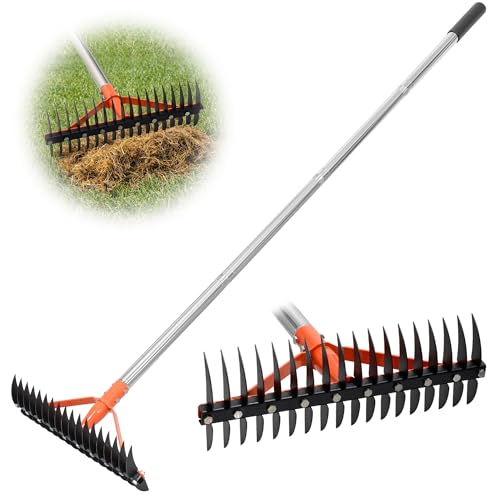
- 18 tempered spring-steel tines
- Dual-sided 15-inch rake head
- Adjustable handle up to 62.5 inches
Best For: Durable seasonal dethatching and soil loosening
Best Multi-Use Rake
BARAYSTUS Dual-Side Thatch Rake

- 19 curved carbon-steel tines
- Adjustable head angle
- Useful for soil and lawn tasks
Best For: Dethatching plus general garden preparation
Adjustable All-Purpose Pick
Suchtale 15-Inch Manual Dethatcher
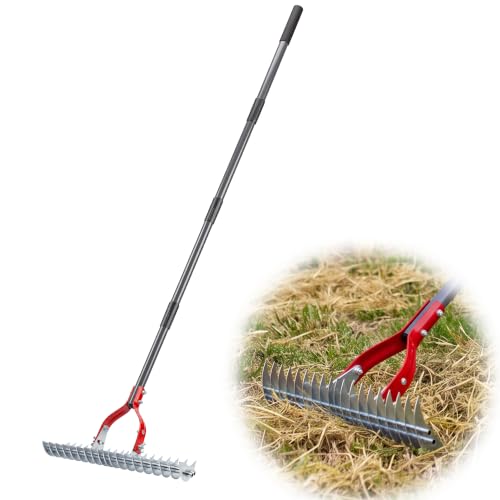
- 19 durable steel tines for thatch and debris
- Adjustable tine angle and handle length
- Detachable design for compact storage
Best For: Versatile seasonal lawn care and cleanup
Two-Sided Heavy-Duty Pick
15-Inch High-Carbon Steel Rake

- Dual-sided head for thatch and surface cleanup
- 19 sharp high-carbon steel tines
- Adjustable handle and head angle with hanging hole
Best For: Small lawns and targeted spot dethatching
Heavy-Duty Reach
74-Inch Adjustable Thatch Rake

- 74-inch adjustable stainless-steel handle
- Dual-sided 19-tine manganese-steel head
- 15-inch width for broad lawn coverage
Best For: Long-reach dethatching and versatile garden cleanup
Low-Strain Choice
Wheeled Adjustable Thatch Rake

- Wheels assist push-and-pull operation
- 37-to-65.35-inch adjustable handle
- 21 stainless-steel tines with adjustable angle
Best For: Reducing strain across open lawn areas
Two-in-One Versatility
55-Inch Stainless-Steel Thatch Rake
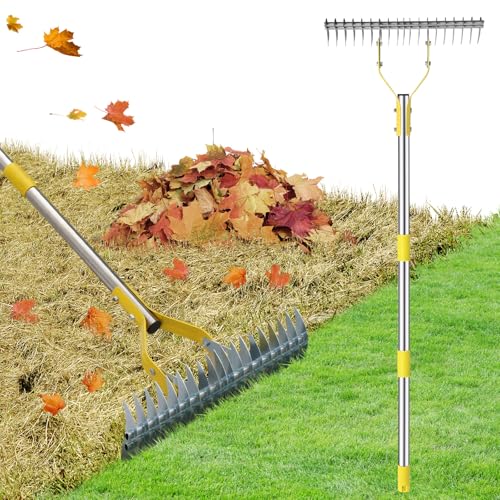
- Dethatching and leaf-raking functions
- Adjustable 19-tine head with 15-inch width
- Stainless-steel build with dual support bars
Best For: Mixed lawn, leaf, and soil-maintenance tasks
Best Adjustable Pick – Walensee 19-Tine Thatch Rake
If you want manual lawn dethatchers with flexible reach, this Walensee rake combines a wide, dual-sided head with three handle lengths. Its curved steel tines are suited to lifting surface thatch and dead grass, while the reverse side helps loosen and cultivate the soil.
Best For: Homeowners who want one adjustable rake for dethatching, light cultivation, and seasonal cleanup.
Pros:
- Dual-sided 19-tine head handles thatch removal and soil loosening.
- Three approximate handle lengths—40, 55, and 70 inches—accommodate different users.
- Powder-coated manganese steel head is designed to resist rust and wear.
- Detachable handle sections simplify transport and storage.
Cons:
- Manual dethatching still requires physical effort.
- Connections should be checked during longer sessions.
The adjustable handle and broad head make this a versatile choice for routine lawn maintenance. It is especially useful when multiple people need to use the same tool or when you want to reduce bending without adding wheels.
Best Heavy-Duty Value – CKLT Dual-Sided Thatch Rake
Among manual lawn dethatchers, this CKLT model emphasizes sturdy construction and a long adjustable handle. Its 18 tempered spring-steel tines are arranged on a dual-sided 15-inch head for pulling deep thatch, clearing surface debris, and loosening compacted soil.
Best For: Small yards and larger gardens that need a durable rake for spring and fall lawn work.
Pros:
- Tempered spring-steel tines have an anti-rust, anti-corrosion coating.
- Dual-sided head separates deep-thatch removal from surface cleanup and soil loosening.
- Three handle settings—34.5, 48.5, and 62.5 inches—help reduce bending.
- 304 stainless steel screws and a reinforced frame support a secure assembly.
Cons:
- The longest handle setting is shorter than some competing models.
- At about 1.87 kg, it may feel substantial during extended use.
This rake is a practical fit if you prioritize a reinforced frame and strong spring-steel tines. Its dual-sided design adds versatility, though users seeking maximum reach may prefer a longer-handled option.
Best Rolling Design – Walensee Wheeled Lawn Dethatcher
This Walensee model stands out among manual lawn dethatchers by adding wheels to reduce pushing resistance. Its one-piece stainless steel blade has adjustable angle and depth settings, giving you more control when removing moss, thatch, leaves, and other lawn debris.
Best For: Homeowners who want a wheeled manual dethatcher with adjustable working depth and extended reach.
Pros:
- Wheels are designed to make pushing across the lawn easier.
- One-piece 2 mm stainless steel blade has no welded joints.
- Blade angle adjusts from 0° to 12°, with depth adjustment up to 5 cm.
- 76.8-inch adjustable handle and rubber grips support a more upright working position.
Cons:
- The rolling design is more specialized than a basic dual-sided rake.
- It may require more setup space than a detachable rake head and handle alone.
If reducing pushing effort is a priority, the wheels and adjustable blade make this an appealing alternative to traditional tine rakes. The long handle and depth controls also suit users who want to fine-tune their approach across different lawn conditions.
Best Multi-Use Rake – BARAYSTUS Dual-Side Thatch Rake
For shoppers comparing manual lawn dethatchers that can handle more than dead grass, the BARAYSTUS rake offers a dual-side carbon-steel head and adjustable working angle. One side is intended for thatch and debris, while the other helps loosen soil, level surfaces, and cultivate.
Best For: Lawn owners who want a detachable rake for dethatching plus general garden preparation.
Pros:
- Dual-sided head includes 19 curved tines for thatch removal and a cultivation side.
- Adjustable head angle can help match working posture and reduce wrist strain.
- Heat-treated carbon steel tines have an anti-rust powder coating.
- Three-section stainless steel handle supports compact storage.
Cons:
- Its stated maximum length is 58.5 inches, shorter than several alternatives.
- The product weighs 3.3 pounds, which may add fatigue during long sessions.
This is a versatile choice for users who want one tool for dethatching, soil loosening, seed spreading, and fertilizer leveling. The adjustable head angle adds control, while the shorter maximum handle may be less suitable for taller users.
Adjustable All-Purpose Pick – Suchtale 15-Inch Manual Dethatcher
For homeowners comparing manual lawn dethatchers, the Suchtale Thatch Rake stands out for its adjustable tine angle and 19 steel tines. Set it for deeper thatch removal or lighter leaf and debris cleanup, then adjust the handle length for a more comfortable reach.
Best For: Versatile seasonal lawn care, including dethatching, leaf removal, soil loosening, and preparing areas for seeding or sod.
Pros:
- Adjustable tine angle supports both deep dethatching and light surface cleanup.
- 19 rust-resistant steel tines are designed for repeated outdoor use.
- Detachable, adjustable handle with a non-slip rubber grip accommodates different user heights.
- Breaks down into compact sections for storage and requires no tools for assembly.
Cons:
- Manual operation still requires pulling the rake across the lawn.
- Handle assembly and adjustment involve connecting multiple sections.
The Suchtale is a flexible choice when you want one manual rake for several lawn-maintenance tasks. Its adjustable head and handle make it especially useful for households sharing tools or managing varied lawn conditions.
Back-Friendly Choice – Wheeled 15.3-Inch Manual Dethatcher
This wheeled option is a practical pick among manual lawn dethatchers if you want to reduce the effort of dragging a rake. Its dual wheels support a push-pull motion, while the adjustable handle and head angle help tailor the tool to your height and lawn task.
Best For: Larger cleanup sessions where reduced arm and lower-back strain, adjustable reach, and included debris-collection accessories are priorities.
Pros:
- Dual support wheels help convert heavy pulling into a smoother push-pull motion.
- 15.3-inch head provides a broad working width for dead grass and debris.
- 35-to-67-inch stainless steel handle adjusts for upright use and different heights.
- Includes protective gloves and a 53-gallon yard waste bag.
Cons:
- Wheeled construction may be less compact than a basic detachable rake.
- The supplied handle range starts at 35 inches, which may not suit every storage setup.
The wheeled design gives this dethatcher a convenience advantage for extended work. It is a strong fit when you want adjustable handling and helpful cleanup accessories alongside the core dethatching function.
Two-Sided Heavy-Duty Pick – 15-Inch High-Carbon Steel Rake
For targeted lawn work, this manual lawn dethatcher combines 19 sharp tines with a dual-sided head. Use the winged side to lift thicker thatch, then flip to the curved side for gathering leaves, grass clippings, or loosening surface soil.
Best For: Small lawns, spot dethatching, dead patches before reseeding, and homeowners who want one rake with two cleanup modes.
Pros:
- Dual-sided 15-inch head handles both thatch cutting and surface gathering.
- High-carbon steel tines, crossbars, and a 1.1-inch steel handle provide a sturdy build.
- Adjustable handle length and head angle support customized use.
- Built-in hanging hole and removable handle sections simplify storage.
Cons:
- Its 15-inch head is better suited to spot work and small lawns than broad-area coverage.
- Manual use requires physical effort to pull up matted thatch.
The standout feature is the flip-style head, which makes the rake more adaptable than a single-purpose dethatcher. Choose it when sturdy construction and two-way cleanup are more important than maximum working width.
Heavy-Duty Reach – 74-Inch Adjustable Thatch Rake
For shoppers comparing manual lawn dethatchers, this model emphasizes reach, broad coverage, and two-sided functionality. Its 15-inch head, 19 curved manganese-steel tines, adjustable handle length, and reversible rake design make it suitable for seasonal thatch and general garden cleanup.
Best For: Homeowners who want a long-handled, dual-purpose rake for dethatching, debris removal, and light soil loosening.
Pros:
- Handle sections adjust up to 74 inches, helping reduce bending.
- Dual-sided head supports dethatching on one side and soil loosening on the other.
- 15-inch manganese-steel head with 19 curved tines provides broad coverage.
- Detachable sections support compact storage and transport.
Cons:
- At 2.1 kg, it may feel heavier than a basic leaf rake.
- Assembly is required before use.
This is a practical choice when maximum reach and versatile seasonal maintenance matter more than the simplicity of a single-purpose rake. The cushioned grip and rust-resistant stainless-steel handle add comfort for longer sessions.
Low-Strain Choice – Wheeled Adjustable Thatch Rake
Among manual lawn dethatchers, this wheeled model is designed to make repeated push-and-pull passes less strenuous. It combines a 16.14-inch, 21-tine stainless-steel head with an adjustable 37-to-65.35-inch handle and a 0-to-12-degree head angle.
Best For: Homeowners seeking a wheeled manual dethatcher that can reduce bending and arm strain during lawn cleanup.
Pros:
- Wheels help support push-and-pull operation and reduce load on the arms.
- Handle length adjusts from 37 to 65.35 inches.
- Adjustable head angle is designed for light or deeper raking, up to a stated 0.8-inch depth.
- Detachable handle sections make storage easier in smaller spaces.
Cons:
- Its wheeled design may be less convenient in tight garden beds or uneven areas.
- The 3.5-pound weight is higher than some simpler rake designs.
The wheels and ergonomic grip are the main reasons to choose this rake. It is especially appealing for larger open lawn areas where reducing physical effort during repeated passes is a priority.
Two-in-One Versatility – 55-Inch Stainless-Steel Thatch Rake
This two-in-one option stands out among manual lawn dethatchers by combining a thatching side with a leaf-raking and soil-loosening side. Its 19-tine, 15-inch head, adjustable angle, 55-inch stainless-steel handle, and dual support bars are suited to varied yard maintenance tasks.
Best For: Homeowners who want one compact tool for dethatching, leaf cleanup, soil loosening, and light ground leveling.
Pros:
- Two-sided head handles deep thatch removal as well as leaves and debris.
- Adjustable head angle supports different raking depths and tasks.
- Stainless-steel construction and dual central support bars are designed for rigidity and rust resistance.
- Detachable handle sections allow compact storage and quick assembly.
Cons:
- Its 55-inch total length offers less reach than the 74-inch model.
- The multi-purpose head may be more tool than needed for users seeking only basic dethatching.
This rake is a strong fit for smaller storage areas and mixed yard work. Choose it when switching between dethatching, leaf gathering, soil loosening, and leveling is more useful than having a specialized single-function tool.
How We Picked These Manual Lawn Dethatchers
We focused on the features that most affect real-world dethatching: tine construction, head width, handle adjustability, working angle, wheel support, and overall versatility. Models with spring-steel or high-carbon steel tines are generally better suited to pulling through compacted thatch than lightweight plastic alternatives. We also included both traditional pull rakes and wheeled designs because they suit different lawns and user preferences.
Product descriptions were compared for practical specifications such as tine count, handle range, head size, and adjustment options. Since manual dethatching depends heavily on technique and lawn condition, the best choice is not necessarily the largest or most aggressive rake.
Quick Comparison
| Type | Best For | Notable Feature |
|---|---|---|
| Dual-sided rake | Versatile seasonal cleanup | Different tine styles or angles |
| Wheeled dethatcher | Longer sessions and larger lawns | Less lifting and more consistent contact |
| Adjustable-angle rake | Varying thatch thickness | Control over tine aggressiveness |
| Long-handle rake | Taller users and broad reach | Reduced bending |
| Compact manual rake | Small yards and garden beds | Easier storage and maneuverability |
Key Buying Factors for Manual Lawn Dethatchers
Tines and Head Design
Look for durable metal tines when removing a dense layer of dead grass. More tines can cover the surface efficiently, while a dual-sided head may provide both aggressive dethatching and lighter raking. Sharp, springy tines should penetrate the thatch without digging deeply into healthy soil.
Handle Length and Adjustability
An adjustable handle lets multiple people use the rake and makes it easier to find a comfortable working height. Longer handles reduce bending, but a very long shaft can be harder to control in tight spaces. Check whether the handle locks securely, especially when applying force.
Wheels and Maneuverability
Wheeled Manual Lawn Dethatchers can reduce lifting and help maintain a more even depth across a larger area. They may be less convenient around trees, edging, and irregular ground, where a standard rake offers better control.
Width, Angle, and Storage
A 15-inch head is a practical middle ground for most residential lawns. Adjustable head angles are useful when switching between light surface cleanup and heavier thatch removal. Consider whether the rake breaks down or telescopes for storage.
Who Should Buy Which Manual Lawn Dethatchers?
Choose a traditional dual-sided rake if you want one tool for dethatching, loosening soil, and gathering lawn debris. A wheeled model is a better fit for users who want less lifting or expect to cover a broad, relatively open lawn. If comfort and posture are priorities, select a model with a long adjustable handle.
For small lawns, garden borders, and areas around landscaping, prioritize maneuverability over maximum width. For thick thatch, choose strong steel tines and an adjustable angle so you can begin gently and increase pressure only where necessary. Whatever style you choose, mow moderately short, work when the soil is slightly moist but not wet, and rake in controlled passes to avoid damaging healthy turf.