The right irrigation timer can keep lawns, garden beds, containers, and drip lines watered on schedule without requiring daily attention. The best option depends on your number of zones, preferred controls, power access, and need for smart features.
We compared these 10 irrigation timers across programming flexibility, zone management, installation style, weather-related controls, and everyday usability to help you choose a dependable fit for your yard.
Best 10 Irrigation Timers Picks for 2026
Best Single-Outlet Pick
RainPoint Programmable Hose Timer

- Custom duration and frequency settings
- Rain delay and manual watering modes
- Large LCD display for schedule visibility
Best For: Single-faucet garden, lawn, and yard watering
Best Multi-Zone Controller
Orbit 4-Station Swing Panel Timer

- Controls four irrigation stations
- Indoor or outdoor locking cabinet
- Cycle-and-soak and rain-skip features
Best For: Residential lawns with multiple watering zones
Best Four-Zone Scheduling

- Independent schedules for four zones
- Hourly-to-weekly programming flexibility
- Seven-day rain delay and manual mode
Best For: Multiple valves with different watering requirements
Best Battery-Free Option

- Battery-free clockwork operation
- Easy-grip oversized adjustment dial
- 15-to-120-minute watering control
Best For: Simple single-hose watering without electronics
Best Smart Controller
Rain Bird ARC8 WiFi Irrigation Timer

- Eight-zone app-based sprinkler control
- Weather-based schedule adjustments
- Alexa and Google Assistant compatible
Best For: Remote control of larger residential sprinkler systems
Best Simple Hose Timer
Orbit 2-Outlet Digital Irrigation Timer

- Two programmable hose outlets
- LCD controls with rain delay
- Water-resistant, battery-powered design
Best For: Basic automated watering from an outdoor faucet
Best Flexible Two-Zone Timer
RAINPOINT Dual-Zone Irrigation Timer

- Independent programming for two zones
- One-minute-to-nearly-four-hour durations
- Rain delay, manual mode, and low-battery warning
Best For: Custom hose watering schedules for gardens and yards
Best Smart Multi-Zone Pick
Orbit B-hyve XD 4-Port Smart Hose Timer
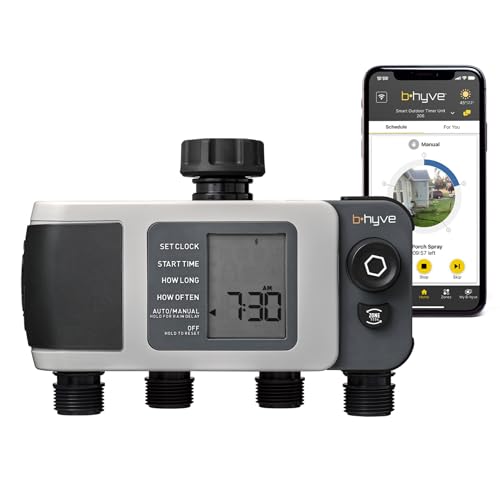
- Four outlets for separate watering zones
- Bluetooth app control and remote scheduling
- WeatherSense adjusts watering for drought conditions
Best For: Connected multi-zone garden watering
Best Flexible Single-Outlet Value
Programmable Outdoor Garden Hose Faucet Timer

- Customizable frequency, duration, and start time
- Auto, manual, and 1–7 day rain-delay modes
- Large LCD with child lock and IP55 protection
Best For: Flexible single-zone outdoor watering
Best Two-Pack for Simple Scheduling
Orbit 62067 Digital Hose Timer 2-Pack

- Includes two programmable one-outlet timers
- Large LCD simplifies schedule setup
- 24-, 48-, and 72-hour rain delay
Best For: Two separate hose-faucet watering locations
Best Single-Outlet Pick – RainPoint Programmable Hose Timer
For straightforward irrigation timers, the RAINPOINT Sprinkler Timer offers programmable control for a single hose outlet. Its adjustable duration and frequency settings make it practical for gardens, lawns, and yards.
Best For: Gardeners who need customizable watering from one outdoor faucet.
Pros:
- Sets watering duration from 1 minute to 3 hours 59 minutes.
- Supports schedules from hourly intervals through every seven days.
- Includes rain delay, manual watering, and a large LCD display.
Cons:
- Controls only one outlet.
- Requires two AA alkaline batteries, which are not included.
This is a useful choice when you want detailed scheduling without managing multiple watering zones. The rain-delay and manual modes add flexibility around changing weather and occasional watering needs.
Best Multi-Zone Controller – Orbit 4-Station Swing Panel Timer
Among irrigation timers for larger residential watering setups, the Orbit 4-Station timer provides independent control across four zones. Its indoor/outdoor installation flexibility and programmable intervals suit established lawn sprinkler systems.
Best For: Homeowners managing up to four residential lawn watering zones.
Pros:
- Controls four stations for multi-zone irrigation.
- Can be mounted indoors or outdoors in a locking cabinet.
- Offers cycle-and-soak windows, stacked runtimes, and rain-skip delay.
Cons:
- Designed as a 24-volt controller rather than a simple hose-faucet timer.
- Its larger cabinet requires more installation space.
With four stations and advanced scheduling features, this Orbit model is better suited to a permanently installed sprinkler system than a basic garden hose. The locking cabinet also adds security for indoor or outdoor placement.
Best Four-Zone Scheduling – Melnor AquaTimer 4-Zone
The Melnor AquaTimer is one of the more flexible irrigation timers for coordinating four independent zones. Each valve can be scheduled from hourly watering through once-weekly operation, with runtimes ranging from one minute to six hours.
Best For: Garden and lawn setups requiring separate schedules for four valves.
Pros:
- Provides independent programming for four zones.
- Supports hourly-to-weekly scheduling and runtimes up to six hours.
- Includes manual watering and a seven-day rain delay.
Cons:
- Requires two AA batteries, which are not included.
- Its four-zone design may be more than needed for a single hose line.
This timer stands out when different areas need different watering schedules. Independent zones and a long runtime range offer more control than a basic single-outlet timer, while manual access helps with occasional hose use.
Best Battery-Free Option – Orbit Mechanical Water Timer
For shoppers who prefer simple irrigation timers without electronics, the Orbit Mechanical Water Timer uses a clockwork shutoff and oversized dial. It provides adjustable watering durations from 15 to 120 minutes for lawn and garden hose use.
Best For: Gardeners seeking battery-free, easy-dial watering control.
Pros:
- Operates without batteries or electronic controls.
- Large dial is easy to adjust with wet or gloved hands.
- Offers adjustable 15-to-120-minute watering durations and manual bypass.
Cons:
- Does not provide digital scheduling or LCD controls.
- Its maximum watering duration is two hours.
This mechanical model is a practical fit for users who value uncomplicated operation and want to avoid battery replacement. Its duration range covers many routine watering tasks, though it lacks the advanced scheduling of digital timers.
Best Smart Controller – Rain Bird ARC8 WiFi Irrigation Timer
If you want app-based control, the Rain Bird ARC8 is one of the most feature-rich irrigation timers in this roundup. Its eight-station design supports indoor or outdoor installation, while the mobile app lets you adjust schedules, start manual watering, and monitor upcoming irrigation remotely.
Best For: Homeowners who want smart, multi-zone sprinkler control with weather-based adjustments and voice-assistant compatibility.
Pros:
- Controls up to eight irrigation zones through the Rain Bird mobile app.
- Can automatically skip or adjust watering based on local weather information and historical averages.
- Works with Amazon Alexa and Google Assistant, with scheduling access from anywhere.
Cons:
- Requires a compatible mobile device and WiFi setup for its smart features.
- Designed for sprinkler systems rather than a simple garden-hose connection.
The ARC8 is a strong choice when convenience and remote access matter more than simplicity. Its weather-responsive scheduling and broad smart-home compatibility make it especially appealing for larger residential irrigation systems.
Best Simple Hose Timer – Orbit 2-Outlet Digital Irrigation Timer
The Orbit 58910 is a straightforward option for turning an outdoor faucet into an automatic watering system. This battery-powered irrigation timer has two outlets, an LCD screen, adjustable watering duration, and a built-in rain-delay function for routine lawn and garden watering.
Best For: Homeowners who need simple, programmable hose-based watering for two outlets without app connectivity.
Pros:
- Dual outlets allow separate hose watering connections.
- LCD display and simple programming make schedules easy to set.
- Includes rain delay, water-resistant construction, and a six-year limited warranty.
Cons:
- Does not offer WiFi, app control, or voice-assistant integration.
- Battery-powered operation requires ongoing battery maintenance.
Choose the Orbit when you want dependable hose automation without the complexity of a smart controller. Its dual-outlet layout is useful for basic garden or landscape zones, while the rain delay helps avoid unnecessary watering.
Best Flexible Two-Zone Timer – RAINPOINT Dual-Zone Irrigation Timer
The RAINPOINT two-zone model is a versatile choice for garden hoses and smaller irrigation setups. It lets you program each zone independently, choose watering durations from one minute to 3 hours 59 minutes, and pause watering for 24, 48, or 72 hours when rain is expected.
Best For: Gardeners who need flexible two-zone scheduling, manual controls, and clear on-device programming.
Pros:
- Independent schedules support different start times, durations, and frequencies for each zone.
- Offers automatic, manual, and rain-delay modes, including separate zone controls.
- Large display, low-battery warning, IP65 waterproof rating, and upgraded valve design.
Cons:
- Uses a 3/4-inch interface, so faucet and pipe compatibility should be checked before purchase.
- Does not provide app-based or remote control.
RAINPOINT stands out among irrigation timers for its scheduling range and hands-on flexibility. It is a practical fit for users managing two hose zones with different watering needs, provided the connection size matches the existing faucet or pipe.
Best Smart Multi-Zone Pick – Orbit B-hyve XD 4-Port Smart Hose Timer
For gardeners comparing irrigation timers, the Orbit B-hyve XD stands out for app control, weather-responsive scheduling, and four separate outlets. It is designed to automate watering across multiple garden, lawn, and flower-bed zones.
Best For: Multi-zone watering and gardeners who want Bluetooth scheduling from a phone.
Pros:
- Four outlets support multiple watering zones.
- Bluetooth app control enables remote scheduling.
- WeatherSense can adjust schedules for drought conditions.
- Backed by a two-year limited warranty for private use.
Cons:
- Bluetooth-based control may not suit shoppers seeking a simple manual timer.
- The four-port design may be more capability than a single-zone setup requires.
This is the most feature-focused option in the group, especially for users who want automated, connected irrigation rather than basic faucet scheduling.
Best Flexible Single-Outlet Value – Programmable Outdoor Garden Hose Faucet Timer
Among irrigation timers, this single-outlet hose faucet model offers detailed scheduling without requiring a phone app. Its dial and buttons control frequency, duration, start time, and operating mode for lawns, gardens, drip systems, and other outdoor uses.
Best For: Flexible single-zone watering with manual control and rain-delay options.
Pros:
- Supports watering intervals from 1 minute to 23 hours 59 minutes or 1 to 7 days.
- Auto, manual, and rain-delay modes cover different watering needs.
- Large LCD screen and child-lock mode make operation easier.
- IP55 waterproof construction and included adapter hardware support outdoor use.
Cons:
- Two AA alkaline batteries are required and are not included.
- One outlet limits it to a single watering zone at a time.
This timer is a practical choice when precise scheduling matters but multi-zone smart features are unnecessary. The rain-delay function is particularly useful for avoiding scheduled watering during wet weather.
Best Two-Pack for Simple Scheduling – Orbit 62067 Digital Hose Timer 2-Pack
If you need straightforward irrigation timers for more than one faucet, the Orbit 62067 two-pack provides one programmable outlet per unit. Each timer uses a large LCD screen and lets you set start time, duration, and watering frequency.
Best For: Homeowners or contractors needing two basic, independently placed hose timers.
Pros:
- Two timers are included for separate watering locations.
- LCD programming controls start time, duration, and frequency.
- Rain delay pauses watering for 24, 48, or 72 hours.
- Programs remain saved when batteries are changed.
Cons:
- Each unit has only one outlet.
- The supplied notes do not specify battery type or battery life.
This two-pack offers a simple way to automate watering at two hose faucets. It is less feature-rich than a smart multi-port controller, but its rain delay and retained programming add useful convenience.
How We Picked the Best Irrigation Timers
We focused on the features that matter most during regular watering: dependable scheduling, simple setup, clear controls, outlet or zone capacity, rain-delay functionality, and compatibility with common garden hoses or irrigation systems. The roundup includes basic mechanical models, programmable hose timers, multi-zone controllers, and app-connected smart options.
We also considered where each timer works best. A one-outlet model may be ideal for a container garden or soaker hose, while a four-zone controller makes more sense for separate lawn, flower-bed, and vegetable-garden schedules.
Quick Comparison
- Best for simple hose watering: Single-outlet digital or mechanical timers.
- Best for multiple hose-connected areas: Two-outlet or four-port hose timers.
- Best for in-ground systems: Multi-station sprinkler controllers.
- Best for app control: Wi-Fi-enabled controllers and smart hose timers.
- Best for power-free operation: Battery-free mechanical timers.
Key Buying Factors for Irrigation Timers
Number of Outlets or Zones
Match capacity to your watering layout. One outlet handles a single hose or line, while two-outlet and multi-zone models let you run different schedules for areas with different sunlight, soil, or plant needs.
Programming Flexibility
Look for adjustable start times, watering duration, frequency, and day selection. Independent zone programming is especially useful when turf needs more water than containers or established shrubs.
Rain Delay and Manual Controls
A rain-delay function helps prevent unnecessary watering after storms, while manual operation lets you run a hose or zone without changing the saved schedule. These controls are valuable for both conservation and maintenance.
Power and Connectivity
Battery-powered timers are convenient for hose faucets and locations without wiring. Smart Wi-Fi models can provide remote scheduling, alerts, and weather-based adjustments, but they require a reliable network and compatible installation environment.
System Compatibility
Check whether the timer is designed for a standard outdoor faucet, drip irrigation, sprinkler valves, or an existing in-ground controller. Confirm connection sizes, required batteries, valve wiring, and outdoor weather protection before buying.
Who Should Buy Which Irrigation Timers?
Choose a basic single-outlet timer if you want affordable, automatic watering for one hose, lawn sprinkler, raised bed, or soaker hose. A two-outlet model is better when you need separate schedules for two watering lines. Select a four-zone hose timer for several faucet-connected areas without installing a wired controller.
For an in-ground sprinkler system, use a multi-station controller with enough zones for current and future valves. Gardeners who want remote access, weather-aware scheduling, or app notifications should consider a smart Wi-Fi model. If you prefer the simplest setup and never want to replace batteries, a mechanical timer is the practical choice—provided its limited scheduling range meets your needs.